UNDERSTANDING PSYCHOTHERAPY

Psychodynamic Psychotherapy Explained Simply: How It Works and What It Changes

UNDERSTANDING PSYCHOTHERAPY By Aris Haegermann May 2026

Contents

How Early Patterns Emerge and How They Change

The formative experiences of our childhood shape us in ways we often don’t notice for a long time. In particular, our relationships with our first attachment figures leave their mark on the way we feel, think, and act.

As children, we lack the freedom to consciously choose certain behaviors. We adopt the behaviors we see modeled. We develop strategies to cope with whatever we encounter. A child who repeatedly experiences having their feelings dismissed learns to hide them. Another child, who is praised for achievements and criticized for mistakes, may develop the belief: I’m only valuable if I’m perfect. In transactional analysis, this type of pattern has its own name: the “Be Perfect” driver.

What exactly does “depth psychology-based” mean in this context? It means looking at where these patterns originated, rather than focusing solely on current behavior.

Depth psychology-based therapy makes tangible what guides us without our noticing: old feelings, relationship patterns, and experiences that have become ingrained in our lives.

What is meant to change must first come to life. Change occurs in contact: when an old experience is met with a different reaction from the other person than expected. When feelings are expressed and taken seriously, or when appreciation is shown even without any specific achievement. That’s when space is created for something new.

The Iceberg Model

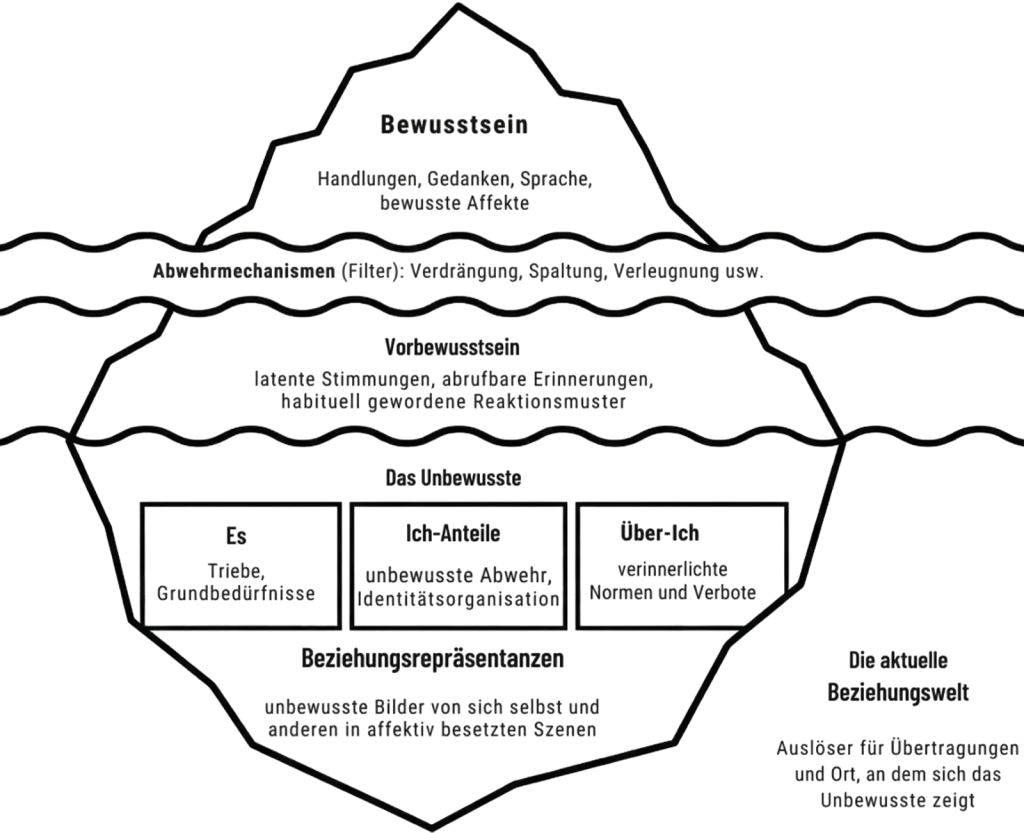
The iceberg model of psychodynamic psychotherapy, with consciousness above the surface and the preconscious, the unconscious, defense mechanisms, the Id, the Ego, the Superego, and relationship representations beneath the surface

Three Levels of the Psyche

Consciousness lies above the surface of the water. It encompasses everything we clearly perceive: our actions, thoughts, speech, and the feelings we are aware of. It is the part of ourselves that we believe we know.

Just below that lies the preconscious mind. What lies there is not constantly accessible to us, but we can tap into it when we direct our attention there: a mood that resonates in the background, a memory that can be recalled, a pattern of reaction that has become so familiar that it happens on its own.

But we don't see most of the iceberg. The unconscious.

The Id, the Ego, and the Superego

The image shows how much or how little of ourselves we are aware of. Yet at this depth, several forces are at work simultaneously, and they are distributed across all levels.

There is the Id: the seat of our instincts and basic needs. The desire for closeness, for recognition, for pleasure, for protection. The Id does not ask whether something is allowed. It simply wants. And it remains the most deeply hidden part of us, almost entirely submerged.

Opposite it stands the Superego: the internalized norms and prohibitions, the rules and ideals that we have adopted from our attachment figures. It tells us what we are allowed to do and what we are not, often in exactly the same tone in which it was once said to us. Sometimes we hear its voice very clearly. Sometimes it operates from the shadows.

The Ego mediates between the two. It organizes who we are and regulates how we deal with what drives us from within and what is forbidden to us. We are aware of part of this. Much of it, including our defenses, takes place unnoticed.

Relationship Representations

The classic psychic agencies describe how our psyche works: what drives, what steers, what forbids. Relationship representations describe what our inner life consists of: specific scenes in which an image of ourselves, an image of the other, and the connecting emotion come together.

And these scenes come first. The agencies do not emerge as finished structures that one then fills; they first take shape out of patterns of interaction that are repeated early on. Relationship representations are the stuff of which the inner world is made. The material comes before the function. The Id, the Ego, and the Superego spend a lifetime working on something that took shape before they did.

These images are not another layer alongside the others. They are the very fabric of our inner world. The Id, the Ego, and the Superego work on them and with them.

The unconscious does not remain submerged. Largely unnoticed by us, it becomes visible in our current relationships. At work, in romantic relationships, and in therapy, what operates beneath the surface emerges.

A young squirrel monkey sits intently on a branch in the green canopy, a symbol of early formative experiences and natural adaptation to the environment during childhood

Anxiety and Defense

In the image, there is a dividing line between consciousness and everything that lies beneath it. It represents defense.

The psyche does not allow everything that goes on within it to enter consciousness unchecked. It keeps some things at bay, rearranges others, keeps some things separate, and does most of this without us even noticing.

Why?

Because some feelings, desires, and memories are linked to fear, the fear of losing the love of people who are important to us. The fear of being punished or shamed. And an even more fundamental one: the fear of being overwhelmed by a feeling that is unbearable.

A child who senses that their anger is threatening their relationship with their parents faces a problem. The anger is there. But showing it seems dangerous. So the mind does what makes the most sense in that moment: it pushes the anger out of consciousness. The child no longer feels it. And along with the anger, the fear also disappears.

Feeling
Impulse · Wish
Anxiety
Internal Tension
Defense
Protective
Strategy
activates leads to conceals

Defense mechanisms are not a flaw. They are an achievement of the psyche, often a wise one, that has carried us through a time when we had no other choice.

Defense as a Filter

There are many such mechanisms, and they do not all work the same way. Some respond to a conflict, that is, to a desire that clashes with an internalized prohibition. They do this by pushing something below the threshold of consciousness. Here are four examples:

Repression: An unbearable feeling or a threatening memory is pushed so far away that, in the end, we no longer even know it ever existed.
Displacement: Frustration with one’s boss spills over into the family in the evening. The feeling is directed at a less threatening substitute target, because the actual target would be too risky.
Reaction formation: Those who fear intimacy come across as deliberately independent. Those who are not allowed to acknowledge their own anger are conspicuously friendly. The forbidden impulse manifests as its opposite.
Rationalization: The real reason remains unconscious, and another, more acceptable one takes its place. Someone does not apply for the job they’ve been hoping for and convincingly explains to themselves that the conditions would have been poor anyway.
As different as these four may seem, they all require the same thing: a reasonably stable inner image of ourselves and of the people who are important to us. Only then can a feeling continue to work behind the scenes without shattering the entire image.

In my article on self-sabotage, I describe what this looks like when success fails to appear right before the finish line.

Defense as Splitting

Splitting is older than these mechanisms and works differently. It doesn’t hide any feelings. It changes the image we form of a person.

To understand this, it helps to look back to the beginning. A very young child experiences their mother in separate moments: Sometimes she is there, warm and good. Sometimes she is out of reach, and in that moment, to the child, she is completely bad. These two mothers do not yet belong together. The child is not yet able to think: That’s the same person who loves me and yet is making me wait right now.

This ability develops over the course of a child’s first few years of life. It becomes more firmly established sometime between the third and fifth year of life. The child can now hold a single, complete image of a person within themselves, an image that encompasses both the good and the bad. This image remains intact, even when the person is currently angry, disappointing, or unavailable. The mother hasn’t disappeared just because she’s upset. She’s still the same person.

As long as we lack this ability, there is only one solution: to keep the incompatible things separate:

Splitting: People and situations are divided into all good or all bad. Not out of malice, but because the ambivalence of loving the same person and being angry with them at the same time would create more inner tension than one can bear. The feeling does not disappear into the unconscious. The image of the other person breaks apart into two separate halves, one good and one bad, that alternate with each other.
Projection: We perceive in others a feeling of our own that we cannot bear in ourselves. It’s not me who’s angry. It’s the other person. The feeling isn’t buried but shifted: from within oneself into another person.
Denial: A reality that would be too painful is simply not perceived.
To name just a few mechanisms of splitting. This early form of defense responds to the most fundamental of the fears mentioned: the fear of being overwhelmed. For those who do not yet have a reliable inner image capable of holding a contradictory feeling, that feeling threatens to overwhelm them. Keeping things separate is then not a form of concealment, but a protection against being overwhelmed.

The Price of Defense

As useful as these mechanisms once were, over time they take their toll.

What we push away doesn’t disappear. What we keep submerged demands to be expressed. It takes energy to keep it submerged permanently, energy that’s then lacking for other things. And it distorts our perception: Those who had to lock away their anger as children often fail to feel it as adults, even when it would be justified and necessary. Those who have come to view closeness as dangerous keep people at a distance who would actually be good for them.

What is kept separate remains divided. The world then repeatedly breaks down into good and evil: people are idealized and soon afterward devalued; relationships swing from closeness to disappointment. And when that separation fails, the very thing it was meant to protect against descends upon us: a feeling that overwhelms us.

The protection that used to help is now holding us back.

How Symptoms Develop

This is often where a symptom originates. It usually requires a trigger: a current situation that closely mirrors the old, unconscious conflict, revives the repressed conflict, and undermines the defenses. The symptom then emerges as a kind of stopgap solution.

1

Trigger
A current situation touches on something emotionally significant.

2

Emotion and Tension
Internal conflicts, anxiety, or old expectations are triggered.

3

Defensive Reaction
Withdrawal, control, brooding, or conformity provide short-term relief.

4

Symptom
This tension manifests itself, for example, as anxiety, exhaustion, or conflict.

5

Repetition
The old pattern is reinforced and will be triggered more quickly the next time.

6

Therapeutic Understanding
The pattern becomes visible, tangible, and changeable.

For a large portion of complaints, the classic neurotic symptoms, it is a compromise: it keeps the conflict and the associated anxiety out of consciousness while at the same time allowing some aspect of the forbidden to emerge, in a coded form. The conflict remains unconscious, but at the cost of the symptom.

Here’s an example. A person is deeply hurt and at the same time angry at a parent whom they still love and need. Feeling this anger seems dangerous: it could threaten the bond and trigger feelings of guilt. So it is kept out of consciousness. But that doesn’t mean it has disappeared. It returns in a transformed form, for example as a constant, agonizing worry that something might happen to that parent. This is precisely where the compromise lies: the hostile impulse finds a disguised expression, as “I could wish you harm” becomes “I’m afraid something bad will happen to you,” and it is simultaneously turned into its opposite. The worry is proof of love rather than hate and at the same time costs the person affected their peace of mind. The real conflict remains hidden, yet is at work the entire time.

Or: Someone learned early on that needing help is shameful, that one must be strong and independent. The longing for closeness and care remains, but openly showing it is impossible. Instead, recurring physical ailments arise, forcing him to slow down and prompting others to take care of him. This, too, is a compromise: the longed-for care is provided, but in a coded way, through the symptom rather than through a request. He is spared the shame of openly appearing needy, but he pays the price with his ailments.

Not every symptom arises in this way. Some symptoms do not stem from a repressed conflict, but rather from a lack of inner resources: for example, the ability to regulate emotions, maintain relationships, or sustain one’s self-esteem. In these cases, the symptom does not hide anything; rather, it reveals a deficiency. This often becomes apparent precisely when life demands something that one was never able to learn: in a new relationship, when starting a course of study, or when entering the workforce.

Trauma-related disorders arise from an experience that was so overwhelming that it could not be processed or made sense of. In situations that remind the person of what happened, the original experience comes back to life, often as if it were happening right now, rather than as a distant memory.

These three paths (conflict, developmental deficit, and trauma) lead to different symptoms and require different therapies.

If symptoms are primarily related to stressful or traumatic experiences, a specific trauma therapy such as EMDR can also make sense.

Trigger
Situation
Conflict
is reactivated
Symptom
as a compromise
Uncovering & Working Through
Making the Conflict Conscious
Conflict Remains Unconscious
Structural Deficit
is overloaded
Decompensation
Deficit Becomes Apparent
Support & Practice
Catch-Up Development in the Relationship
Deficit Persists
Trauma
is reactivated
Reliving
instead of a memory
Stabilization & Trauma Therapy
Safety Before Confrontation
Trauma Remains Unintegrated

The Goal of Psychodynamic Treatment

Depth psychology-based psychotherapy focuses on identifying the internal and external triggers that have led to the current symptoms. It does not aim to completely transform the entire personality or to work through one’s entire life story.

The goal is to work with the patient to understand and change only those aspects that are contributing to the current problem. In this way, treatment can help correct distorted perspectives, make up for deficits, and enable the patient to better cope with current life situations. This focus distinguishes the depth psychology-based approach from classical psychoanalysis, which is more comprehensive and long-term in nature.

Whether a therapy is depth psychology-based or structured as psychoanalysis depends primarily on its scope and focus. Both approaches share the same understanding of the unconscious. Psychoanalysis works more broadly and over a longer period of time, while depth psychology-based work stays with what keeps the current symptoms going.

Not All Psychodynamic Psychotherapy Works the Same Way

Depth psychology-based psychotherapy works in two different ways, depending on the nature of the problem.

Conflict-Oriented Work

Repressed conflicts continue to affect us as long as they remain hidden. In therapy, they are brought to light: As a patient, you come to recognize what truly drives you, which old desires, fears, or hurts continue to have an impact to this day.

But recognition alone is not enough. What was not allowed back then now needs space: the grief that was never mourned. The anger that was never allowed to be shown. The longing that was seen as a weakness. In therapy, these feelings can finally be expressed and met by someone who responds with understanding and acceptance.

This brings about a fundamental change. You come to realize, in a tangible way, that your feelings are allowed and that you can be understood along with them. What had been exerting power in secret for years loses its terror.

In my practice, I have often witnessed just how powerful this moment can be: when someone voices for the first time what they have hidden from themselves for years and realizes that they are not being judged for it.

Similar ideas can also be found in Gestalt therapy, which works more with awareness, direct experience, and what is becoming tangible in contact right now.

Allowing Missing Abilities to Mature

Inner abilities originally develop within relationships. A child learns to calm down because it has been calmed down often enough. It can comfort itself because it has been comforted. It can view itself positively because it has been viewed positively.

What was missing back then can be made up for later. The therapist offers comfort where no one else did. He sees something valuable where you may see only a lack.

This isn’t a lesson but an experience. You learn that someone will stay by your side when you’re upset, and over time, you become able to calm yourself down. You experience comfort and learn to comfort yourself. Little by little, this external experience becomes an internal ability.

When Old Patterns Emerge in the Room

At the beginning, an image was mentioned: The unconscious does not remain submerged; it seeks out a place where it can become visible. The therapeutic relationship is one such place, too.

What a person has learned early on about themselves and others, they bring into every new relationship without noticing, including the one with me. Someone who has learned that closeness is followed by disappointment will expect that disappointment here as well. Someone who has learned that feelings are not welcome will hold them back even in the therapy room. This reemergence of old relationship patterns in the here and now is called transference. It can often be recognized by the fact that a reaction doesn’t quite fit the actual situation, comes with a strong emotion, and can hardly be resolved through rational explanations.

Transference is not a problem, but an opportunity. What would otherwise merely be talked about becomes immediately palpable in the relationship, and for that very reason can be worked on.

Early Relationships
Expectations · Formative Experiences
Today
Partner · Work · Family
Therapy
Understanding in the Here and Now
Core Idea
Therapy doesn't just ask what's happening right now, but also whether old expectations regarding closeness, distance, criticism, or recognition are repeating themselves in today's relationships.

These patterns trigger something in me as a therapist as well. I might feel the pressure to step in and offer reassurance, or a subtle irritation, or the desire to withdraw. These internal reactions are called countertransference. Instead of simply following them, I ask myself: Why am I reacting this way right now? What does this say about what’s happening between us at this moment? In this way, my own experience becomes a tool that helps me understand a person’s inner world, which often cannot be fully grasped through words alone.

This brings us full circle to what this form of therapy is fundamentally about. The old pattern is not only understood; it resurfaces in the relationship, where it is met with a different response than the one expected. The corrective experience that was already mentioned lies precisely in this difference.

The Relationship in Psychodynamic Therapy Is More Than a Framework

In depth psychology-based therapy, the relationship between patient and therapist is not merely the framework within which healing takes place. It is itself a key factor in the therapeutic process.

Trust, empathy, and reliability create the conditions under which change becomes possible for patients in the first place. For many people, the corrective experience of this relationship is already an essential part of healing: experiencing stability, feeling accepted, and sensing emotional presence. What was missing in childhood can be experienced differently here for the first time.

But a positive atmosphere alone is not enough for effective treatment. Only when difficult, conflictual dynamics are actively addressed and worked on does the relationship reach its full therapeutic depth. The quality of the relationship is thus both a prerequisite for good therapeutic work and its result.

In the article “What Works in Psychotherapy?” I describe in more detail which factors make psychotherapy effective in general.

A macaque mother sits on a rock in the rainforest, holding her baby close to her chest to protect it

Change Takes Time and Patience

Depth psychology-based therapy does not promise quick solutions. The patterns that are weighing on us today have developed over years or decades. Understanding and changing them takes time. It also requires a willingness to engage in a process that is not always pleasant.

It is not clear from the outset how long depth psychology-based psychotherapy will take. Short-term therapy involves up to 24 sessions, while long-term therapy involves up to 100.

If you first want to sort out whether psychotherapy is the right step at all, you can do so in online psychological counseling.

I work exclusively online. How my online psychological counseling sessions work, what they cost, and how you can get an appointment is explained on the home page.

Risks, Side Effects, and Where the Limits Lie

Psychotherapy works, and anything that works can also have adverse effects. Research draws the following distinctions: An adverse event is anything that happens during treatment, regardless of its cause. A side effect is something different, namely an unwanted reaction to a properly delivered treatment. A treatment error is yet another matter.

First, you should keep in mind that things may temporarily get worse when, for example, a conflict that someone has long avoided comes to the surface. Second, the therapeutic relationship can become so important that it itself becomes an issue, and that needs to be addressed. Third, the environment sometimes changes as well: For example, someone who stops conforming may face resistance from people who were comfortable with the old way of doing things.

None of that is a reason to avoid it. It’s a reason to talk about it before it happens, and again while it’s happening. How often side effects occur and what is true about the criticism of the approach is covered in a separate article.

What Health Insurance Covers, and What Applies in My Practice

Depth psychology-based psychotherapy is one of the guideline-based approaches. This means: Statutory health insurance covers it if there is an illness within the meaning of the Psychotherapy Guidelines and the application is approved. Four approaches are listed there: behavioral therapy, systemic therapy, and the two psychoanalytically based ones, namely depth psychology-based psychotherapy and analytical psychotherapy.

The number of sessions is set differently for each approach, and the difference is greater than most people expect:

Approach (Adults, Individual Therapy) Approval Step Upper Limit
Analytical Psychotherapy up to 160 sessions 300 sessions
Depth Psychology-Based Psychotherapy up to 60 sessions 100 sessions
Behavioral Therapy up to 60 sessions 80 sessions
Systemic Therapy up to 36 sessions 48 sessions

In both cases, short-term therapy comes first: twice for up to 12 sessions, with an application required each time. These sessions are not added on top: Approved short-term therapy is counted toward the long-term therapy quota. An approval step may only be exceeded if the treatment goal has not yet been achieved but there is a reasonable prospect of achieving it.

In my practice, this works differently. I don’t have a statutory health insurance license, and I offer psychological counseling, not treatment. So there’s no application, no expert reviewer, and no diagnosis reported to a health insurance provider, and therefore none of those session limits either. Anyone who needs treatment can find out how to get it in the article on searching for a psychotherapist.

Frequently Asked Questions About Psychodynamic Therapy

What does “depth psychology-based” mean?

“Depth psychology” means that the approach works with the unconscious, with feelings, patterns, and beliefs that are not consciously accessible to us but that shape our experience. “Based” refers to its scientific foundation in psychoanalysis. In international usage, depth psychology-based treatment is also referred to as psychodynamic psychotherapy; in German-speaking countries, it is sometimes also called dynamic psychotherapy.

For which mental disorders and illnesses is this approach effective?

The depth psychology-based approach has been scientifically shown to be effective for a wide range of mental disorders. However, mental disorders in and of themselves reveal little about what ails a person. What matters for the work is which conflicts or missing abilities lie behind them. The range includes depression, anxiety disorders, trauma-related disorders, personality disorders, psychosomatic complaints, and eating disorders. It can also facilitate profound change in cases of difficulties that cannot be clearly attributed to a single diagnosis, such as recurring relationship problems, chronic feelings of emptiness, or persistent self-esteem issues.

How does psychodynamic psychotherapy differ from other forms of therapy?

Compared to behavioral therapy, which focuses more on observable behavior, depth psychology-based therapy addresses the unconscious causes underlying the symptoms. Unlike classical psychoanalysis, it is more limited in time, more focused on current conflicts, and does not involve free association on the couch. In addition to these three approaches, systemic therapy has also been approved as a guideline-based approach in Germany since 2020. Which approach is right depends on the nature of the issues, the individual’s personality, and their personal expectations. Many therapists offer an initial consultation to help clarify this.

Is this therapy also suitable for children and adolescents?

Yes. Depth psychology-based therapies are also available for adolescents and children, provided by therapists who are specially trained in this area. The therapeutic setting is adapted to the patient’s age: With younger children, therapy often involves play or creative media, while with adolescents, the focus is more on conversation. Especially for children who suffer from anxiety, social difficulties, or emotional distress, understanding their inner dynamics can spark lasting change.

Is psychodynamic psychotherapy also offered in hospitals?

Yes. The approach is offered not only on an outpatient basis in psychotherapy practices, but also on an inpatient basis in psychiatric and psychosomatic clinics, as well as in day clinics. There, it is often integrated into a multimodal treatment plan that also includes group therapy, body-oriented therapy, and other approaches. Inpatient admission is particularly suitable for severe cases or acute crises that require closer support.

Does psychodynamic psychotherapy also help with psychosomatic complaints?

Psychosomatic complaints, physical symptoms to which psychological stress contributes substantially, are among the classic areas of application for depth psychology-based psychotherapy. Whether it’s chronic pain, gastrointestinal issues, or skin problems: when the body expresses what the mind cannot, that is precisely where therapy begins. This approach has a particularly long tradition in psychosomatic medicine. The physical aspect remains important as well. A sports scientist from Cologne explains why stretching for chronic pain often doesn’t help.

When should I see a psychiatrist instead of a psychotherapist?

A psychiatrist is a specialist physician in psychiatry and psychotherapy. A psychiatrist can prescribe medication, whereas a psychotherapist generally cannot. For certain conditions, such as severe depression with suicidal thoughts, acute psychosis, or bipolar disorder, concurrent psychiatric treatment is advisable or necessary. In many cases, psychotherapy and psychiatric treatment complement each other. Your therapist will let you know if concurrent psychiatric treatment is recommended.

How long does psychodynamic psychotherapy last?

Short-term therapy consists of up to 24 sessions, while long-term therapy consists of up to 100 sessions, with the option to extend. Sessions typically take place once or twice a week. The duration depends on the depth of the issue and the therapy goals that are set. Patients with structural difficulties (that is, a lack of internal capacities that must first mature) often benefit from longer courses of treatment.

If you need psychological counseling, you can find out more about what I offer here. View my services Close

Via videoWorldwide

Initial Consultation

50 minutes

We’ll focus on what’s on your mind right now and discuss what might help you move forward.

€150
Book 50 minutes

In-Depth Initial Consultation

90 minutes

Time to describe your situation calmly and work on what is especially important to you.

€270
Book 90 minutes

All prices are final. No VAT will be charged.

Packages

For further sessions, if you’d like to continue after the initial consultation. View prices Close

Single Session

1 × 50 minutes

Another look at a current concern. Or a session from time to time.

€150per session
Book a session

Five Sessions

5 × 50 minutes

Explore a topic in depth, draw on everyday experiences, and work together to determine what helps you.

€700€140 per session
Book a package

Ten Sessions

10 × 50 minutes

Regular support over an extended period of your life, with room for new developments.

€1,300€130 per session
Book a package

The packages consist only of 50-minute sessions. The initial consultation is booked and billed separately. If this arrangement doesn’t work out for you, I’ll refund you the amount for the remaining package sessions.

Good to Know

The process, preparation, and costs of your counseling. Learn More Close

What does “initial consultation” mean?

The initial consultation is a 50- or 90-minute counseling session for which a fee is charged. We’ll get to know each other and begin working on your concerns right away. Afterward, you can decide whether you’d like to schedule additional sessions.

Do I need to book a package afterward?

You can leave it at a single session or book additional appointments individually. A package is another option if you’ve decided to have multiple sessions.

How do I prepare?

You don’t need to write anything out in detail. If you’d like, you can jot down what’s on your mind and what you hope to get out of the session. For the video call, you’ll need a quiet place, a stable internet connection, and a camera and microphone.

What does the counseling agreement cover?

Before your first paid session, you will receive information regarding services, fees, payment, canceling appointments, and confidentiality. The agreement also explains how personal data is handled and how the relationship is terminated.

Does health insurance cover the costs?

This counseling service is available to self-pay clients. I do not bill health insurance for this service.