FIND PSYCHOTHERAPY

PTV 11: The Form from the Psychotherapy Consultation

FIND PSYCHOTHERAPY By Aris Haegermann 5 min read July 2026

Contents

At the end of the psychotherapy consultation, the first appointment on the path to psychotherapy, you are handed a sheet with several boxes: the PTV 11 form. Its official title is “Your Individual Information on the Psychotherapy Consultation,” a nationwide standardized form issued by the National Association of Statutory Health Insurance Physicians (KBV).

It summarizes two things on a single page: the preliminary findings from the conversation and a recommendation for how to proceed with psychotherapy.

Where the Form Comes From

What is a PTV form?

A PTV form is one of the forms used to handle outpatient psychotherapy in statutory health insurance, from the consultation to the expert opinion. The KBV calls them PTV form sheets. They are governed by the Psychotherapy Agreement, a contract between the KBV and the National Association of Statutory Health Insurance Funds (GKV-Spitzenverband). Section 25 of the Agreement lists them, from PTV 1 to PTV 12, and in paragraph 10 describes PTV 11 as “an individually prepared patient information sheet on the outpatient psychotherapy consultation.”

The Psychotherapy Guidelines of the Federal Joint Committee (G-BA) require that you receive such information. Under Section 11, paragraph 14, you receive written feedback on the outcome of the consultation “in the form of a patient-friendly findings report,” with recommendations on how to proceed. In addition, you receive a general information sheet on outpatient psychotherapy during the consultation, the PTV 10.

The Psychotherapy Consultation

The psychotherapy consultation is the conversation at the end of which the form is created. The Psychotherapy Agreement governs it in Section 14, paragraph 1: It takes place “in sessions of at least 25 minutes, up to six times per case of illness, and up to ten times per case of illness for children and adolescents.” Before a trial session, acute treatment, or guideline-based therapy, at least 50 minutes of this must have taken place, according to paragraph 3 of the same section. This explains the practical rule of “once for 50 minutes or twice for 25 minutes”: both options meet the requirement.

In its own patient information sheet, KV Bayern consistently refers to the psychotherapy consultation as an “initial consultation.”

Who Fills Out the Form, and Who Does Not

The psychotherapist who conducted the conversation fills out the form right at the end of the appointment.

For colleagues in psychotherapy who fill out the form themselves, the National Association of Statutory Health Insurance Physicians has published its own form-filling guide.

The Five Fields in Detail

Five fields appear on the form, each with its own purpose.
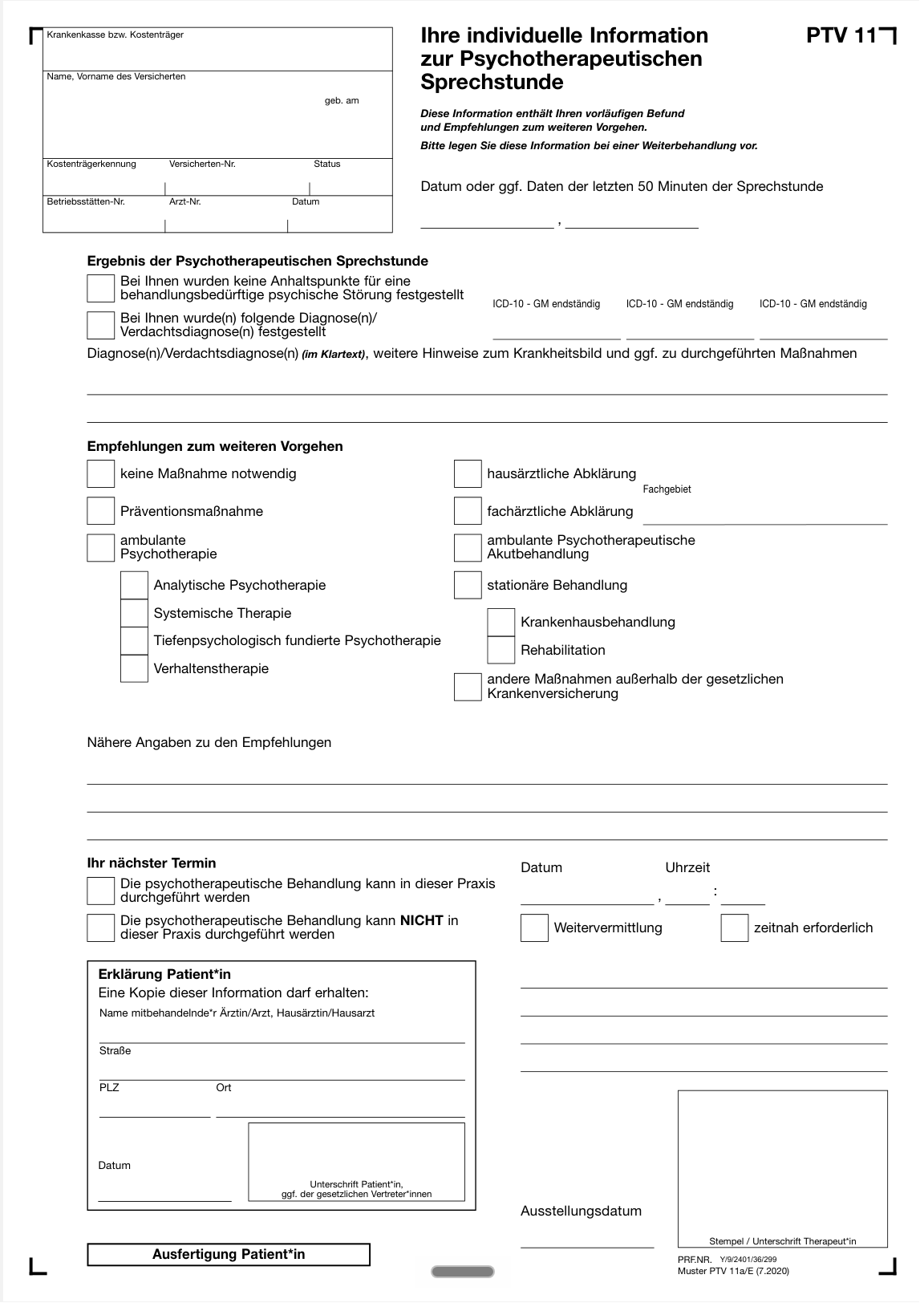
Patient copy of the psychotherapy form with all five fields

Field 1: The Date

This indicates when the psychotherapy consultation took place: once for 50 minutes or twice for 25. This is mandatory before every trial session, every acute treatment, and every guideline-based therapy, that is, the actual psychotherapy.

Field 2: The Findings

There are two boxes to choose from. Either “No indications of a mental disorder requiring treatment were found in your case,” or “The following diagnosis(es)/suspected diagnosis(es) were found in your case,” with space for up to three ICD-10 codes. Below that is a separate line: Diagnosis(es)/Suspected diagnosis(es), in plain language. The form requires the diagnosis to be written out in full: a letter code alone is not sufficient.

Field 3: The Recommendations

Several options can be selected here; the list is long: no action required, preventive measures, outpatient psychotherapy using the four guideline-based approaches (analytical, systemic, depth psychology-based, and behavioral therapy), assessment by a primary care physician, assessment by a specialist physician (with the specialty field), outpatient psychotherapeutic acute treatment, inpatient treatment, hospital treatment, and rehabilitation. The last box has its own wording: “Other measures outside of statutory health insurance.” More on that later.

Field 4: Your Next Appointment

This is where it is determined whether a referral code for psychotherapy will be issued and how urgent the psychotherapeutic treatment is. More on this in the next section.

Field 5: The Patient’s Statement

The last field is yours: You decide whether your primary care physician gets a copy, with space to enter the name and address.
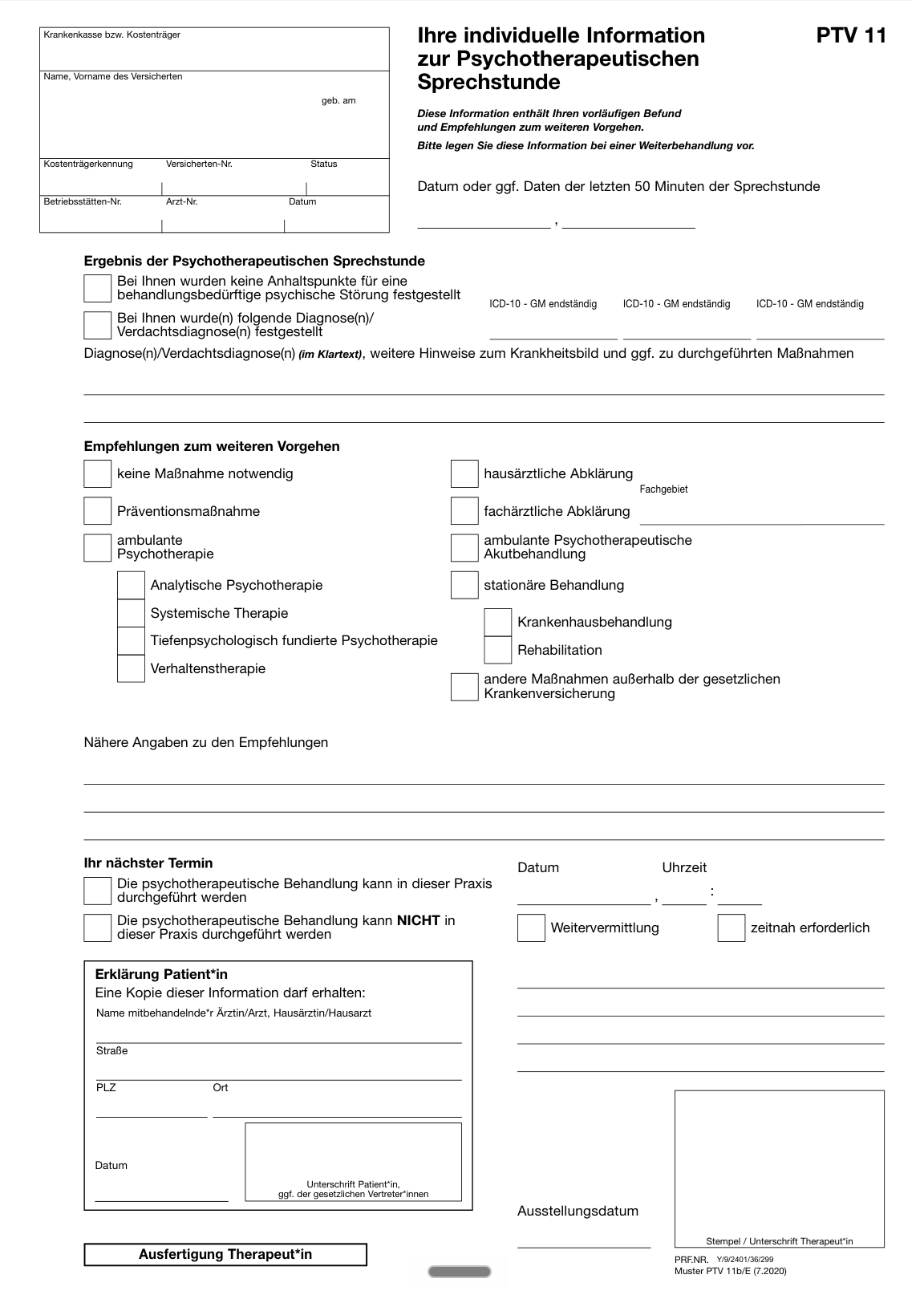
Practice copy of the form, identical in text to the patient copy

The form is provided in duplicate, with identical text generated by carbon copy: form PTV 11a for you, form PTV 11b for the practice. The only difference in the footer is between “Patient Copy” and “Therapist Copy.” It’s a good idea to briefly glance over the form when you receive it. If you have a question or notice an error, just give the practice a call, even the next day, and they’ll usually correct it without any trouble.

What to Do with the Form

The Check Mark That Matters: Required Promptly

Only the check mark next to “required promptly” opens the path to the appointment service center (TSS). Without this check mark, there is no entitlement to an arranged trial session; with it, there is. In the case of a recommended acute treatment, the rules are clear: both “onward placement” and “required promptly” must always be checked.

It can take up to 35 days from your request to the appointment service center until the actual appointment; for an acute treatment, it is up to three weeks. Details can be found on the page about the urgency code.

What to Do With It Now

Present this information for further treatment. So the sheet does not belong in a drawer; it goes along to the next practice or treatment center.

If “onward placement” is checked in Field 4, a referral code comes with it. With this code and your insurance number, you contact the TSS via the phone number 116117; the TSS then looks for a spot for the recommended trial sessions or acute treatment. What exactly the code can do and where it reaches its limits is explained in detail on its own page about the referral code.

How Long the Form Is Valid

There are two different time limits involved in this question. The form itself has no expiration date: Neither the Psychotherapy Agreement nor the KBV’s form-filling guide specifies a validity period, and the forms have been in circulation unchanged since July 2020. Instead, the referral code for psychotherapy is time-limited, and the rules for it can be found on the page about the urgency code.

Where to Get the Form

You will receive the form from your practice. It is not intended for you to print out yourself: The Psychotherapy Agreement expressly requires psychotherapists to have these forms available during consultations. It is a duplicate set with a carbon copy.

Anyone who searches for it online anyway will mainly find samples and templates from commercial providers. For the actual allocation, only the form from the practice where the consultation took place counts.

An Overview of the Twelve Forms

The so-called PTV 11 form is one of twelve forms that are part of the Psychotherapy Agreement:

  • PTV 1: Application for Psychotherapy
  • PTV 2: Therapist Information
  • PTV 3: Guide for the Report to the Expert Reviewer
  • PTV 4: Order for Expert Review
  • PTV 5: Expert Opinion
  • PTV 6 and PTV 7: vacant
  • PTV 8: Envelope for the Expert Review Procedure
  • PTV 9: vacant
  • PTV 10: General Patient Information on Outpatient Psychotherapy
  • PTV 11: Individual Patient Information on the Outpatient Psychotherapy Consultation
  • PTV 12: Reporting of Acute Treatment

If You Cannot Get a Spot in Psychotherapy

Not every referral through the TSS leads to a therapy spot. If the search is unsuccessful or the referral code expires, you can initiate a new referral. Under certain conditions, the reimbursement procedure may also be an option: You look for a psychotherapist on your own and apply to your health insurance provider to have the costs covered. How this works is explained on my page about reimbursement for psychotherapy.

The PTV 11 form also has a box labeled “Other measures outside of statutory health insurance.” This is not a third route to a therapy spot but a catch-all category for forms of assistance that are not part of regular psychotherapy covered by statutory health insurance. Examples could be a counseling center for family, life, or addiction issues, a social psychiatric service, or a self-help group. The specific help that is recommended should be listed in the “Further details on the recommendations” field.

Psychotherapy that you pay for yourself in a private practice also takes place outside the statutory health insurance system. However, the box alone is neither a recommendation for it nor an assurance that the health insurance provider will cover the costs.

Outside the statutory health insurance system, there is also online psychological counseling. It requires no application and has no waiting list, but it is of limited duration and does not result in a diagnosis.

Frequently Asked Questions

Where can I find a template for the form?

You receive the PTV 11 form from the practice where your psychotherapy consultation took place. Although commercial templates for psychotherapy are available online, they do not count for the actual allocation.

Who is allowed to fill out the form?

The psychotherapist fills it out, right at the end of the psychotherapy consultation. The primary care physician does not issue it: People who search for it online usually mean the consultation report or the referral to psychotherapy.

What do I do with this form?

Present it to the next practice or treatment center for your psychotherapy; this is stated at the top of the form. If “onward placement” is checked in Field 4, a referral code comes with it, which you use to look for a spot for psychotherapy through 116117.

How long is the form valid?

The form itself has no expiration date. Only the referral code for psychotherapy, which you can receive along with it, is valid for a limited time.

If you are interested in online psychological counseling, you can find out more here. View my services Close

Via videoWorldwide

Initial Consultation

50 minutes

We’ll focus on what’s on your mind right now and discuss what might help you move forward.

€150
Book 50 minutes

In-Depth Initial Consultation

90 minutes

Time to describe your situation calmly and work on what is especially important to you.

€270
Book 90 minutes

All prices are final. No VAT will be charged.

Packages

For further sessions, if you’d like to continue after the initial consultation. View prices Close

Single Session

1 × 50 minutes

Another look at a current concern. Or a session from time to time.

€150per session
Book a session

Five Sessions

5 × 50 minutes

Explore a topic in depth, draw on everyday experiences, and work together to determine what helps you.

€700€140 per session
Book a package

Ten Sessions

10 × 50 minutes

Regular support over an extended period of your life, with room for new developments.

€1,300€130 per session
Book a package

The packages consist only of 50-minute sessions. The initial consultation is booked and billed separately. If this arrangement doesn’t work out for you, I’ll refund you the amount for the remaining package sessions.

Good to Know

The process, preparation, and costs of your counseling. Learn More Close

What does “initial consultation” mean?

The initial consultation is a 50- or 90-minute counseling session for which a fee is charged. We’ll get to know each other and begin working on your concerns right away. Afterward, you can decide whether you’d like to schedule additional sessions.

Do I need to book a package afterward?

You can leave it at a single session or book additional appointments individually. A package is another option if you’ve decided to have multiple sessions.

How do I prepare?

You don’t need to write anything out in detail. If you’d like, you can jot down what’s on your mind and what you hope to get out of the session. For the video call, you’ll need a quiet place, a stable internet connection, and a camera and microphone.

What does the counseling agreement cover?

Before your first paid session, you will receive information regarding services, fees, payment, canceling appointments, and confidentiality. The agreement also explains how personal data is handled and how the relationship is terminated.

Does health insurance cover the costs?

This counseling service is available to self-pay clients. I do not bill health insurance for this service.