
FIND PSYCHOTHERAPY

Consultation Report for Psychotherapy

FIND PSYCHOTHERAPY By Aris Haegermann 3 min read July 2026

Contents

What is a consultation report?

A consultation report is a physician’s written assessment, obtained after the trial sessions at the latest and before the start of the actual guideline-based therapy. The official form is called Muster 22 and is titled “Consultation Report Prior to the Start of Psychotherapy” in its 2014 version.

This page describes the rules governing statutory health insurance (GKV). Different conditions apply to people who are privately insured, to people who receive the healthcare allowance for civil servants (Beihilfe), and to self-pay patients.

The report is required for treatment by psychological psychotherapists and child and adolescent psychotherapists; the current regulations also specify specialist psychotherapists for adults as well as for children and adolescents. Those receiving treatment from a medical psychotherapist do not need the form.

It is issued by a contracted physician, whom the Psychotherapy Guidelines call a consulting physician. The focus is on assessing physical causes and on the question of whether a psychiatric assessment is necessary.
Why a Doctor Takes a Look Before Therapy

Before treatment begins, it should be clarified whether a physical illness is the cause of the symptoms. That is precisely the purpose of the medical assessment. The law refers to the assessment of a somatic illness, not its exclusion, and the difference is not mere semantics: A physical finding does not settle the matter. Physical and mental health are considered equally important, and in this case, the form includes the field “Medical co-treatment is required.”

The consulting physician also checks whether a psychiatric assessment is necessary, whether medical co-treatment should be added, and whether further medical examinations are needed. These are three separate fields on the form, each with its own question.

For some, this additional appointment feels like an obstacle to addressing the actual concern. In an acute crisis, however, it does not get in the way: the psychotherapy consultation and acute treatment continue without it. The appointment service center must arrange an appointment for acute treatment within one week, and that appointment can be no more than two weeks after that week, so at most three weeks in total. The precondition is that acute treatment was recommended to you on the PTV 11 form during the consultation. Anyone discharged from a hospital or a rehabilitation facility due to a mental illness does not need this PTV 11.

Who is authorized to complete the consultation report?

Section 32 of the Psychotherapy Guidelines specifies who is authorized to complete the consultation report. Almost all contracted physicians are authorized to do so. Certain specialties are excluded: laboratory physicians, microbiologists, and infectious disease epidemiologists, as well as specialists in nuclear medicine, pathology, radiology, radiation therapy, transfusion medicine, and human genetics. When a child is involved, the list is more limited: in such cases, pediatricians, child and adolescent psychiatrists, internists, general practitioners, and family physicians are eligible.

In practice, this is often handled by the primary care physician. The consultation report is issued by the doctor who examined you in person.

What is examined for the consultation report?

The Psychotherapy Guidelines do not prescribe a fixed list of physical examinations or laboratory test results. The scope of the examination depends on your symptoms, medical history, and the physician’s assessment. Two things are specified: that the consulting physician examines you in person, and what should be on the form afterward.

Above the findings field is the sentence “Information on the following should be provided, if applicable:” Below that is the list: current symptoms, information on the psychological and somatic findings, relevant medical history, medical diagnoses, differential and suspected diagnoses, relevant prior and concurrent treatments (inpatient or outpatient) along with current medication, plus findings that make accompanying medical treatment or a psychiatric examination necessary. The Psychotherapy Guidelines list nine points. The “if applicable” on the form means that not every case needs complete information on every point.

The doctor does not determine whether you need treatment. You will discuss this with your therapist; the doctor provides input based on your physical and psychiatric symptoms.

Four fields on the form directly affect you. Two of them are checkboxes related to the medical findings: “Medical co-treatment is required” and “Based on somatic/psychiatric findings, there are currently contraindications for psychotherapeutic treatment.” The doctor will only check these boxes if he or she actually finds evidence to support them. The third field concerns the psychiatric assessment and offers four options to check: required, not required, completed, or arranged. The fourth is a free-text field asking whether medical or medically ordered measures and examinations are necessary or have already been ordered.

Muster 22 Form, Field by Field

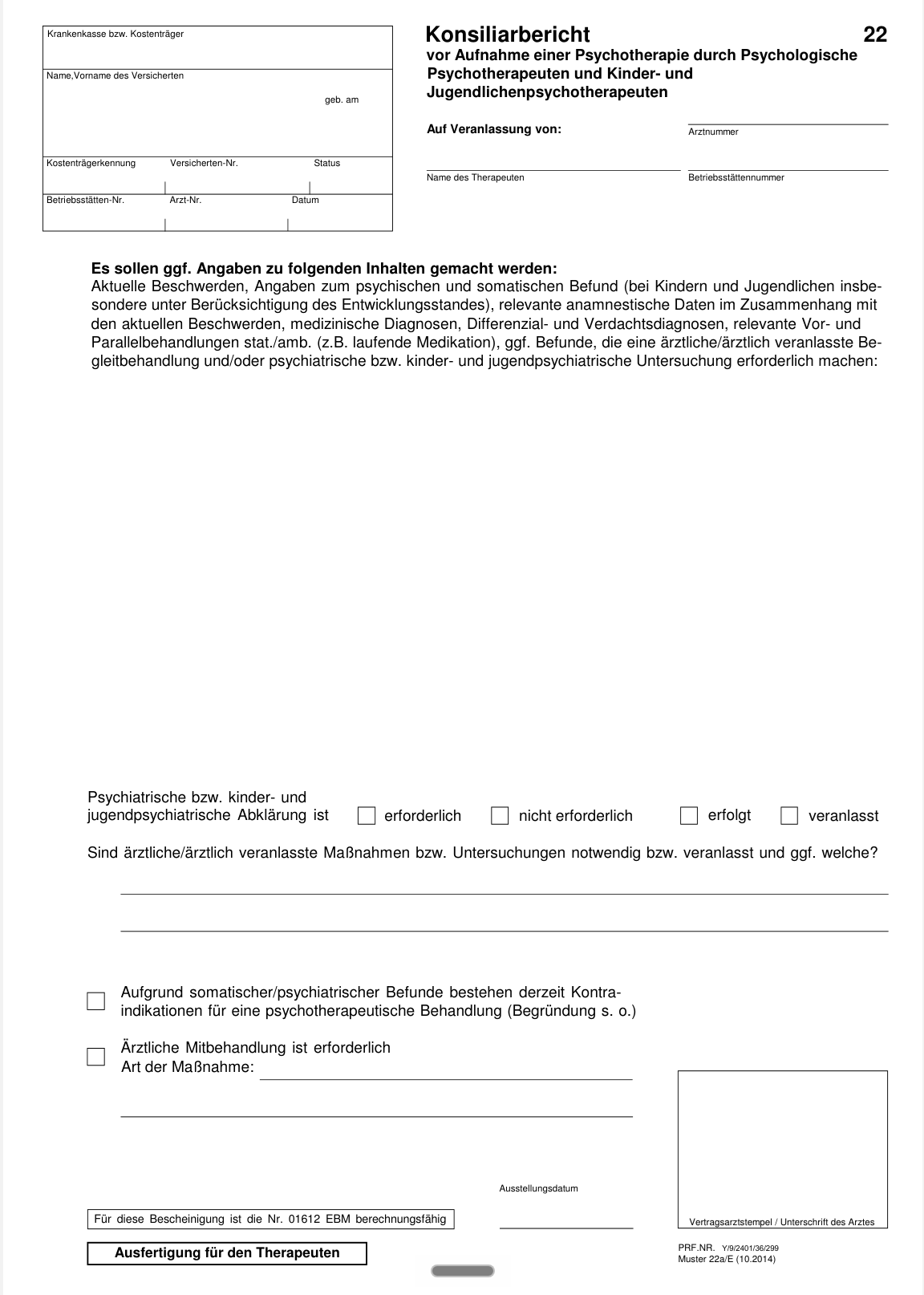
The Muster 22 form is a four-part set: 22a goes to the therapist, 22b to the expert reviewer, 22c remains with the consulting physician, and 22d goes to the health insurance provider. As the patient, you do not receive a copy of your own.

The report is requested using a specific form. The therapist writes a referral on the Muster 7 form, “Referral Prior to the Start of Psychotherapy to Assess Somatic Causes,” and enters the diagnoses and the indication there. The Muster 22 form is the response to this referral.

On the form, the doctor enters, among other things, the health insurance provider and the payer ID, as well as the patient’s name and date of birth, insurance number and status, facility number and physician number, the date of issuance, a field labeled “At the request of,” and one for the “Type of measure.” At the bottom are the contracted physician’s stamp and signature.

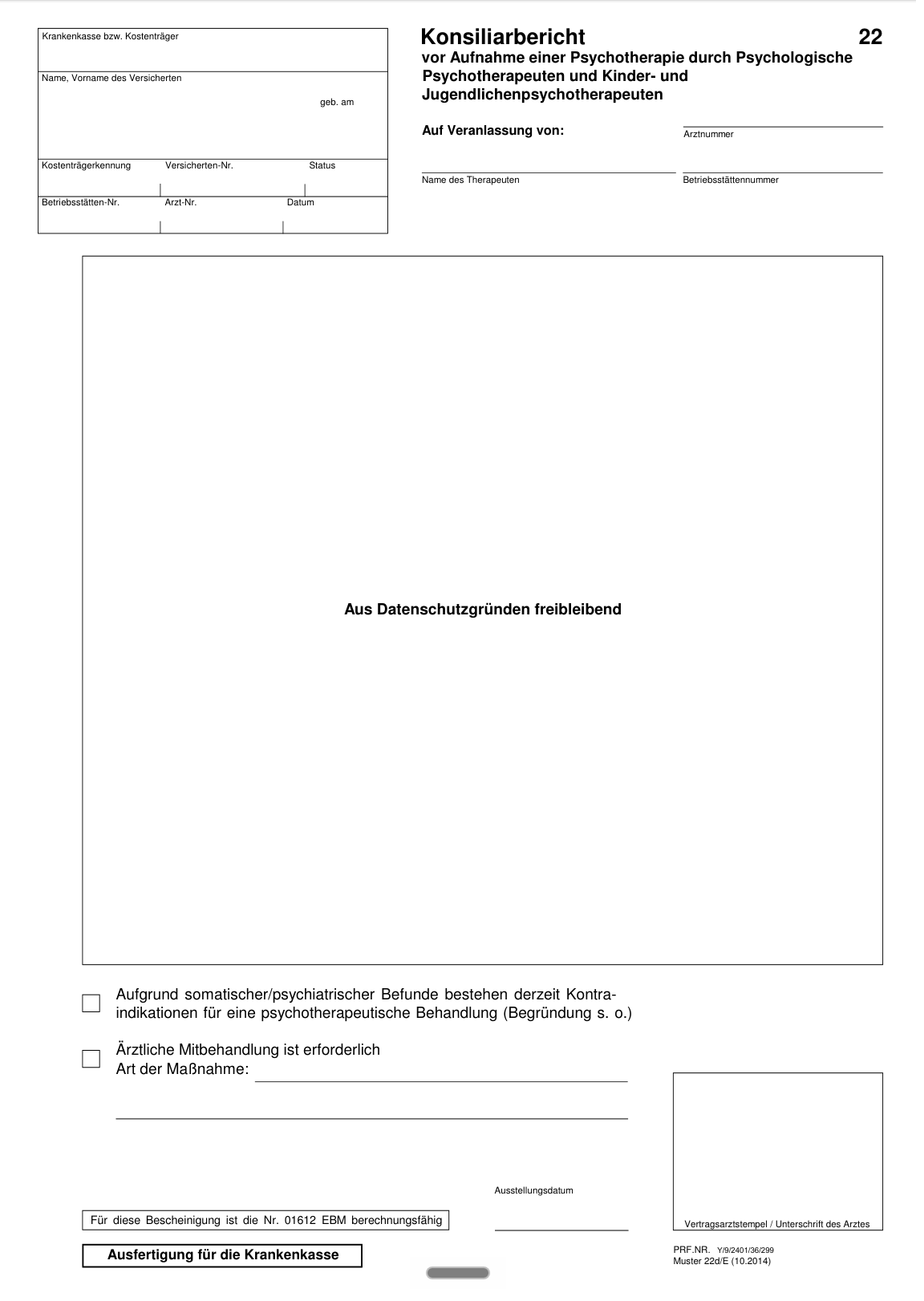
The four sheets have the same layout, but they are not identical. On the sheet for the expert reviewer, your name is replaced by a code consisting of the first letter of your last name and your date of birth, and on the sheet for the health insurance provider, the free text on the findings is missing entirely. The doctor can prepare the consultation report as soon as he or she has examined you in person and the therapist has requested it.

Muster 22 form, copy for the therapist: at the top, fields for health insurance provider, insured person’s information, physician ID number, and facility ID number; below that, instructions on which information the physician should provide

Muster 22a/E form, the copy for the therapist, version 10.2014, printed using the blank form procedure. The top third is visible; clicking on the image displays the entire sheet.

Muster 22 form, copy for the health insurance provider: the same header with the insured person’s information, but in place of the physician’s findings, there is an empty box with a note stating that it is left blank for data protection reasons

The same form, sheet 22d/E, for the health insurance provider. Where the findings are listed on the therapist’s sheet, there is an empty box here, and in the middle of it, in bold, it says “Left blank for data protection reasons.” This sheet also opens fully with a single click.

Why You Cannot Print the Form Yourself

A printout of the image on this page is not a usable form. You can still view the form; it is available at the top of this page, sheet by sheet, just as medical practices actually use it.

There are two approved ways to produce the Muster 22 form, and both go through the practice. One is the official set of forms: four sheets of carbonless copy paper, glued at the top, printed in machine-readable dropout colors. The other is blank form printing. Here, the practice software prints the four sheets individually on security paper, which features a watermark and a UV print on the back. For this, the software must be verified by the National Association of Statutory Health Insurance Physicians (KBV), and it prints its verification number on the sheet as well. The image above was created exactly this way; the verification number is at the bottom right.

Health insurance providers pay for the security paper, and it may be used exclusively for work done by contracted physicians. This means neither way is open to patients. For this reason, this page deliberately offers no download. That’s on purpose.

Is the Muster 22 form available as a PDF?

Yes, but only for viewing. The KBV publishes the binding samples of the forms as a PDF in a sample collection, where the four sheets of the consultation report appear on pages 41 to 44. Each sheet bears the imprint “Verbindliches Muster” (binding sample). Under the Forms Agreement (Vordruckvereinbarung), these samples are the print templates for producing the forms, and precisely these two words are not printed on the finished form.

You take the referral on the Muster 7 form, issued by your therapist, to the doctor’s office. After the examination, the doctor fills out the consultation report on one of the practice’s forms. Since July 30, 2026, the report is no longer required if a physician with a statutory health insurance license has referred you for psychotherapy, and in certain cases after hospital treatment.

The Path from the Appointment to the Sealed Envelope

After the examination, the consulting physician fills out the form and forwards it to the therapist. The form should be forwarded as soon as possible, but no later than three weeks after the examination. This statement is included on the referral form itself, so the physician has it right in front of them.

If an expert review procedure takes place, a copy is also sent to the expert reviewer in a sealed envelope. Applications for the following are typically subject to expert review: long-term therapy as individual therapy and as combination treatment that is primarily conducted as individual therapy, as well as the transition from short-term therapy to these forms. Pure group therapy and combination treatments conducted primarily in a group setting are not routinely subject to expert review; however, the health insurance provider can still require an expert review on a case-by-case basis. The form for the envelope is designated PTV 8. It is processed through the health insurance provider, which forwards it unopened.

There is no provision for you to receive a copy of it. You may, however, review the report: According to Section 630g of the German Civil Code, you have the right to review your medical records; the first copy is free of charge.

What the Doctor Learns and What the Health Insurance Provider Sees

The health insurance provider sees very little medical information. On its copy, sheet 22d, in the section for free-text findings on the 2014 version of the form, it states literally and in bold: “Left blank for data protection reasons.” What the doctor notes regarding symptoms, medical history, and diagnoses is not included there.

Two pieces of information are still sent to the insurer: whether there is a contraindication, and whether medical co-treatment is required, in the latter case along with the type of measure. Free-text entries are excluded. The checkboxes are included.

During the examination, the doctor learns firsthand what you describe to him and what he observes physically. This information is recorded on the sheets for the therapist and the expert reviewer, though the expert reviewer sees you only as a code. Diagnoses and the content of your conversations are not forwarded to the health insurance provider via this form.

The application for therapy, on the other hand, does reach the insurer, and the diagnosis is part of it. Anyone who wants nothing on file with a health insurance provider at all should stay outside the statutory health insurance system. In online psychological counseling, neither an application nor a reported diagnosis is created.

When a Consultation Report Is Required and When It Is Not

The consultation report is required before guideline-based therapy, that is, before the psychotherapeutic treatment itself. The psychotherapy consultation, trial sessions, and acute treatment proceed independently of it, as does basic group psychotherapy.

An additional exception has been in effect since July 30, 2026. Section 28, Paragraph 3, Sentence 4 of Book V of the Social Code (SGB V) has since read: “A consultation report is not required if the psychotherapeutic treatment is provided upon referral by a contracted physician or upon the recommendation of a hospital following psychiatric, psychosomatic, or psychotherapeutic inpatient treatment.” The new regulation was introduced by the Statutory Health Insurance Contribution Rate Stabilization Act, published on July 29, 2026, in the Federal Law Gazette (BGBl. I No. 228).

The legislature has thus relaxed the requirements for some cases. The KBV comments: “One positive development is that psychotherapists no longer have to request a consultation report when patients are receiving treatment based on a physician’s referral.”

In December 2025, the Federal Joint Committee (G-BA) opened its own deliberation procedure on the consultation report process (Resolution 7625). On October 15, 2026, it adopted an amendment to the Psychotherapy Guidelines, Resolution 8073. Among other things, the amendment incorporates the new statutory exception, but it is not yet in force. It will only take effect once the Federal Ministry of Health raises no legal objection to it and the G-BA has published the resolution in the Federal Gazette (Bundesanzeiger). Neither the Psychotherapy Guidelines nor the Federal Framework Agreement incorporates the new statutory exception so far; the law and the regulations are temporarily at odds with one another.

If the Primary Care Physician Refuses to Provide the Report

If the primary care physician refuses to provide the consultation report, there are several options available. Another contracted physician can step in, as long as his or her specialty is not among those excluded.

The law does not recognize an explicit entitlement to this specific form. Nevertheless, two rules are helpful: A contracted physician may refuse to treat a patient with statutory health insurance only in justified cases, and whoever has taken on the case must also prepare the report following the in-person examination.

The appointment service center, which can be reached at 116117, does not offer appointments specifically for this purpose. However, it does arrange an appointment with a primary care physician, and no referral is required for that. The Federal Framework Agreement sets two deadlines for it: It must arrange the appointment within one week of your call, and the wait after that may not exceed four weeks. This is not a substitute for legal advice, but it provides a practical point of contact before the start of treatment is further delayed.

Billing: What the Doctor Gets Paid

For the consultation report, the Uniform Assessment Standard (EBM) provides service code 01612, valued at 37 points or 4.71 euros, as of the third quarter of 2026. The number is printed on the form itself: “For this certificate, EBM No. 01612 is billable.”

Whether the doctor bills for it separately depends on the doctor’s specialty. In primary care and in pediatrics and adolescent medicine, the service is included in the flat-rate fee for insured patients, so there is no additional charge. Doctors in other specialties bill for it separately. Billing is handled through the Association of Statutory Health Insurance Physicians. The psychotherapy practice bills the trial sessions separately; how trial sessions under the EBM are compensated is explained on a separate page.

Patients with statutory health insurance do not incur any out-of-pocket costs as a result. The service is provided in kind by the health insurance provider; the law does not provide for a copayment for medical treatment.

For privately insured patients, different rules apply.

Frequently Asked Questions

What is the difference between a consultation report and a consultation examination?

The consultation examination is the medical appointment that takes place before psychotherapy covered by statutory health insurance, during which it is determined whether a physical illness is the underlying cause of your symptoms or needs to be treated concurrently. To this end, the psychotherapist will refer you to a doctor. Almost any contracted physician can perform the examination; in practice, it is often handled by a primary care practice. The doctor who signs the report must have examined you in person beforehand. The Psychotherapy Guidelines do not prescribe a fixed list of physical examinations; the scope depends on your symptoms, medical history, and the doctor’s assessment. A psychiatric assessment is only added if the examining physician deems it necessary.

The consultation report is the result of this examination: the completed Muster 22 form, which the doctor fills out after the appointment and sends to your therapist as soon as possible, no later than three weeks after the examination. In everyday language, the two terms are often used interchangeably, and they usually refer to the same process: the doctor’s visit prior to treatment and the form that results from it.

Who issues the report if I do not have a regular primary care physician?

Almost any contracted physician can issue it, regardless of whether you have a regular primary care physician. Certain specialties are excluded, such as laboratory medicine, radiology, or pathology. If you don’t have a regular doctor, a nearby physician who can offer an appointment on short notice can often help. To do so, they must have examined you in person before signing the form.

How soon does the therapist need to receive the report?

The report should be sent as soon as possible, but no later than three weeks after the examination. This deadline applies only to the process from the doctor to the therapist, calculated from the date of the examination. There is no specific deadline for the subsequent transmission to the health insurance provider. If you wish to follow up, it is best to check directly with the therapist for the current status.

Will I receive a copy of the report?

No, the form does not provide for a separate copy for you. The Muster 22 form consists of four sheets: one for the therapist, one for the expert reviewer, one for the issuing physician, and one for the health insurance provider. You may still request to review it. The German Civil Code grants you the right to your complete medical records; the first copy is free of charge, and the consultation report is included in those records.

What does it mean when a doctor checks a box indicating a contraindication?

The doctor checks the box for contraindications only if he or she actually identifies a physical or psychiatric finding that argues against starting psychotherapeutic treatment. If an application is submitted anyway, the health insurance provider arranges for an expert review by the Medical Service. Both checkboxes refer to the physician’s findings, not to an assessment of the patient’s motivation.

Is the report always required?

As a rule, yes, for individuals with statutory health insurance before guideline-based therapy. It is not required for the psychotherapy consultation, for trial sessions, for acute treatment, or for basic group psychotherapy. Since July 30, 2026, it is also no longer required if the treatment is provided based on a referral from a contracted physician or is recommended following inpatient psychiatric, psychosomatic, or psychotherapeutic treatment.

If you are interested in online psychological counseling, you can find out more here. View my services Close

Via videoWorldwide

Initial Consultation

50 minutes

We’ll focus on what’s on your mind right now and discuss what might help you move forward.

€150
Book 50 minutes

In-Depth Initial Consultation

90 minutes

Time to describe your situation calmly and work on what is especially important to you.

€270
Book 90 minutes

All prices are final. No VAT will be charged.

Packages

For further sessions, if you’d like to continue after the initial consultation. View prices Close

Single Session

1 × 50 minutes

Another look at a current concern. Or a session from time to time.

€150per session
Book a session

Five Sessions

5 × 50 minutes

Explore a topic in depth, draw on everyday experiences, and work together to determine what helps you.

€700€140 per session
Book a package

Ten Sessions

10 × 50 minutes

Regular support over an extended period of your life, with room for new developments.

€1,300€130 per session
Book a package

The packages consist only of 50-minute sessions. The initial consultation is booked and billed separately. If this arrangement doesn’t work out for you, I’ll refund you the amount for the remaining package sessions.

Good to Know

The process, preparation, and costs of your counseling. Learn More Close

What does “initial consultation” mean?

The initial consultation is a 50- or 90-minute counseling session for which a fee is charged. We’ll get to know each other and begin working on your concerns right away. Afterward, you can decide whether you’d like to schedule additional sessions.

Do I need to book a package afterward?

You can leave it at a single session or book additional appointments individually. A package is another option if you’ve decided to have multiple sessions.

How do I prepare?

You don’t need to write anything out in detail. If you’d like, you can jot down what’s on your mind and what you hope to get out of the session. For the video call, you’ll need a quiet place, a stable internet connection, and a camera and microphone.

What does the counseling agreement cover?

Before your first paid session, you will receive information regarding services, fees, payment, canceling appointments, and confidentiality. The agreement also explains how personal data is handled and how the relationship is terminated.

Does health insurance cover the costs?

This counseling service is available to self-pay clients. I do not bill health insurance for this service.