
FIND PSYCHOTHERAPY

Consultation Report Psychotherapy

FIND PSYCHOTHERAPY Von Haegermann 3 min. reading time July 2026

Contents

What is a consultation report?

A consultation report is a physician’s written assessment, obtained no later than after the trial sessions and before the start of the actual guideline-based therapy. The official form is called Form 22 and is titled „Consultation Report Prior to the Start of Psychotherapy,“ in its 2014 version.

This page describes the rules governing statutory health insurance (GKV). Different conditions apply to those with private insurance, those receiving a health insurance subsidy, and those who pay out of pocket.

The report is required for treatment by psychological psychotherapists and child and adolescent psychotherapists; the current regulations also specify specialist psychotherapists for adults as well as for children and adolescents. Those receiving treatment from a medical psychotherapist do not need the form.

It is issued by a participating physician, who Psychotherapy Guidelines Call him a consulting physician. The focus is on ruling out physical causes and determining whether a psychiatric evaluation is necessary.
Why a doctor should examine it before treatment

Before treatment begins, it must be determined whether a physical illness is the cause of the symptoms. That is precisely the purpose of the medical evaluation. The law refers to the evaluation of a somatic illness, not its exclusion, and the difference is not mere semantics: A physical finding does not settle the matter. Physical and mental health are considered equally important, and in this case, the form includes the field „Medical co-treatment is required.“.

The consulting physician also determines whether a psychiatric evaluation is necessary, whether additional medical treatment should be provided, and whether further medical examinations are needed. These are three separate sections on the form, each with its own question.

For some, this additional appointment feels like an obstacle to addressing the actual issue. In an acute crisis, however, it does not get in the way: clinic hours and acute care continue without it, and the Federal Framework Agreement gives the appointment scheduling office a maximum of two weeks to schedule an acute care appointment.

Who is authorized to complete the consultation report?

Section 32 of the Psychotherapy Guidelines specifies who is authorized to complete the consultation report. Almost all contracted physicians are authorized to do so. Certain specialties are excluded: laboratory physicians, microbiologists, and infectious disease epidemiologists, as well as specialists in nuclear medicine, pathology, radiology, radiation therapy, transfusion medicine, and human genetics. When a child is involved, the list is more limited: in such cases, pediatricians, child and adolescent psychiatrists, internists, general practitioners, and family physicians are eligible.

In practice, this is often handled by the family doctor. The consultation report is issued by the doctor who examined you in person.

What the Doctor Examines

The psychotherapy guidelines do not prescribe a fixed list of physical examinations or laboratory test results. The scope of the examination depends on your symptoms, medical history, and the physician’s assessment. Two things are specified: that the consulting physician must examine you in person, and what information must be included on the form afterward.

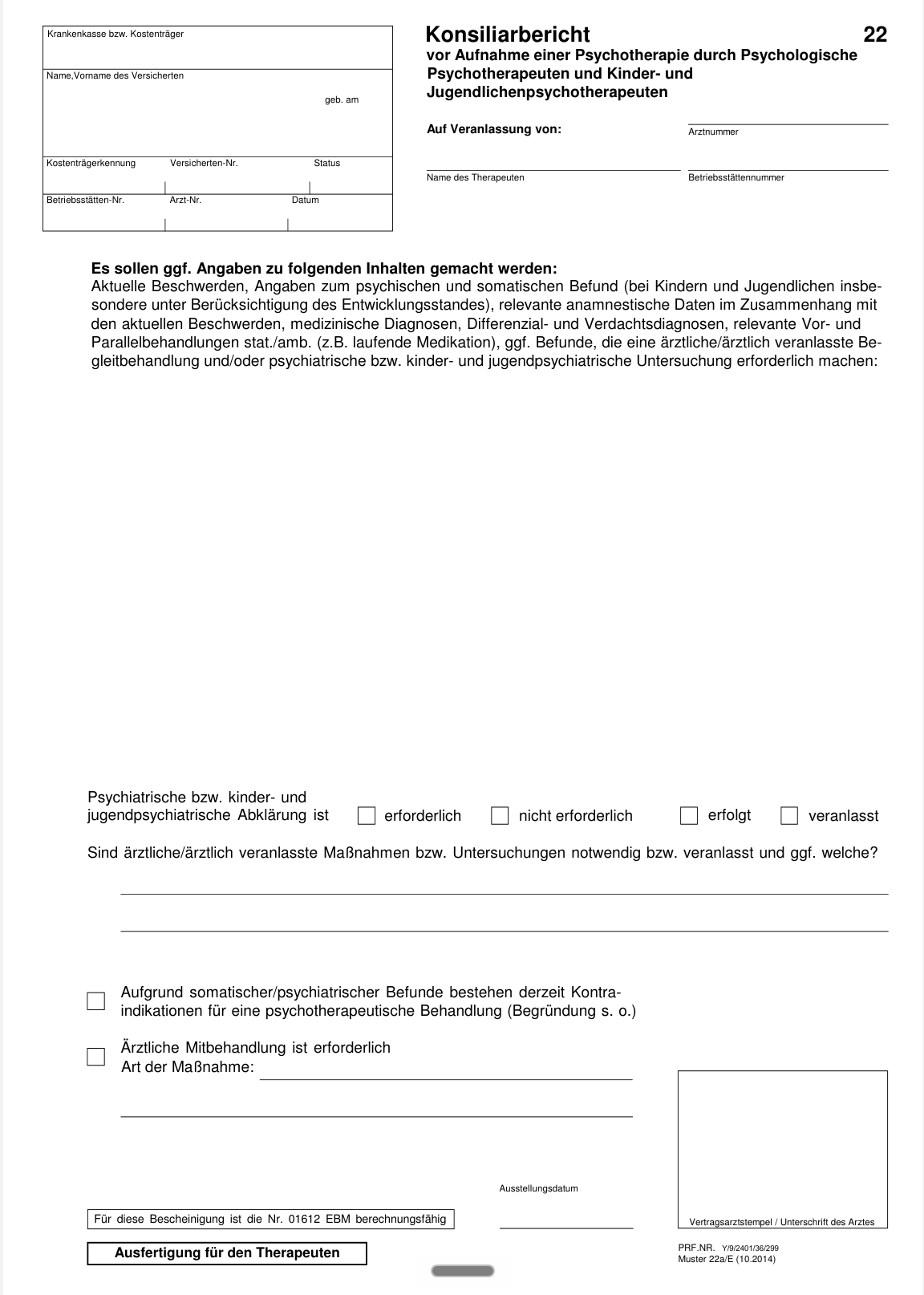
Above the findings section is the sentence, „If applicable, provide information on the following:“ Below that is the list: current symptoms, information on psychological and physical findings, relevant medical history, medical diagnoses, differential and suspected diagnoses, relevant prior and concurrent treatments—whether inpatient or outpatient—including current medication, as well as findings that require concurrent medical treatment or a psychiatric evaluation. The guideline lists nine points. The phrase „if applicable“ on the form means that not every case requires information for every point complete information is needed.

The doctor does not determine whether you need treatment. You will discuss this with your therapist; the doctor provides input based on your physical and psychiatric symptoms.

Four fields on the form directly affect you. Two of them are checkboxes related to the medical findings: „Medical co-treatment is required“ and „Based on somatic/psychiatric findings, there are currently contraindications for psychotherapeutic treatment.“ The doctor will only check these boxes if he or she actually finds evidence to support them. The third field concerns the psychiatric evaluation and offers four options to check: required, not required, completed, or arranged. The fourth is a free-text field asking whether medical or medically ordered measures and examinations are necessary or have already been ordered.

Pattern 22, Field by Field

Form 22 is a four-part set: 22a goes to the therapist, 22b to the medical examiner, 22c remains with the consulting physician, and 22d goes to the health insurance company. As the patient, you do not receive a copy of the form.

The report is requested using a specific form. The therapist writes a referral on Form 7, „Referral Prior to the Start of Psychotherapy to Assess Somatic Causes,“ and enters the diagnoses and the indication there. Form 22 is the response to this referral.

On the form, the doctor enters, among other things, the health insurance provider and the cost-bearer ID, as well as the patient’s name and date of birth, insurance number and status, facility number and physician number, the date of issuance, a field labeled „At the request of,“ and one for the „Type of procedure.“ At the bottom are the contracted physician’s stamp and signature.

The four forms have the same layout, but they are not identical. On the form for the medical expert, your name is replaced by a code consisting of the first letter of your last name and your date of birth, and on the form for the health insurance company, the free-text section for the findings is missing entirely. The doctor can prepare the consultation report as soon as he or she has examined you in person and the therapist has requested it.

Form 22, Copy for the Therapist: at the top, fields for health insurance provider, insured person’s information, physician ID number, and facility ID number; below that, instructions on which information the physician should provide

Form 22a/E, the copy for the therapist, version 10.2014, printed using the blank form method. The top third is visible; clicking on the image displays the entire page.

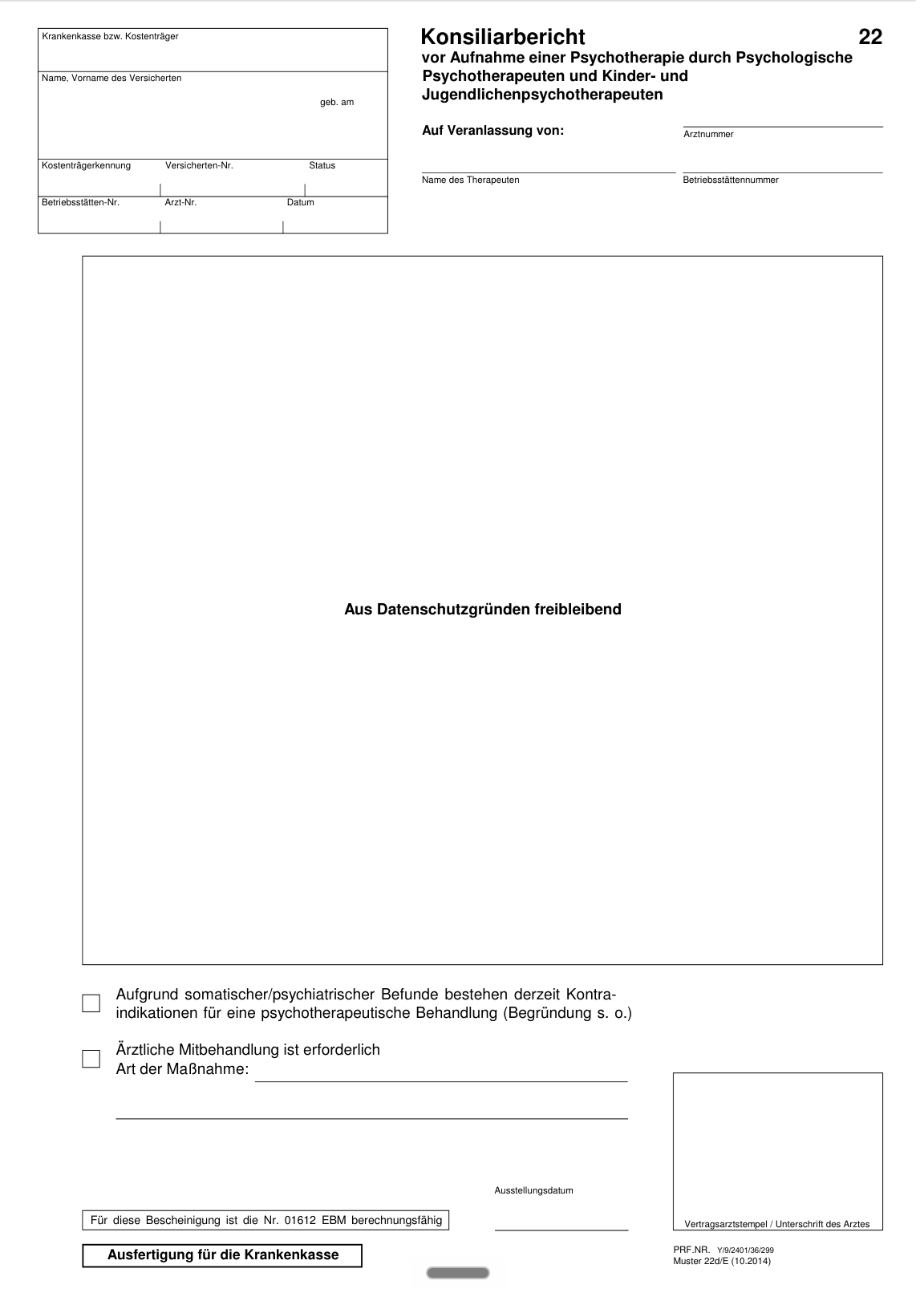
Form 22, copy for the health insurance provider: the same header with the insured person's information, but in place of the physician's findings, there is an empty box with a note stating that it is left blank for data protection reasons

The same form, Sheet 22d/E, for the health insurance company. Where the findings are listed on the therapist’s sheet, there is an empty box here, and in the middle of it, in bold, it says, „Subject to change for data protection reasons.“ This sheet also opens fully with a single click.

Why You Can't Print the Form Yourself

A printout of the image on this page is not a usable form. You can still view the form; it is available at the top of this page, page by page, just as medical practices actually use it.

There are two approved methods for Form 22, and both involve practical application. One is the official set of forms: four sheets of carbonless copy paper with a pre-printed header, printed in machine-readable blind colors. The other is the Printing on Blank Forms. The practice software prints the four sheets individually on security paper, which features a watermark and a UV print on the back. To do this, the software must be certified by the National Association of Statutory Health Insurance Physicians (KBV) and prints its certification number on the sheet. The image above was created exactly this way; the certification number is located in the lower right corner.

Health insurance companies pay for the medical form, and it may be used exclusively for work performed by doctors under contract. Neither option is therefore available to patients. This page therefore deliberately offers No download ... That's on purpose.

The Journey from the Appointment to the Sealed Envelope

After the examination, the consulting physician fills out the form and forwards it to the therapist. The form should be forwarded as soon as possible, but no later than three weeks after the examination. This statement is included on the referral form itself, so the physician has it right in front of them.

If an expert review is conducted, a copy is also sent to the expert in a sealed envelope. Applications for the following are typically reviewed: Long-term therapy as individual therapy and as combination treatment that is primarily conducted as individual therapy, as well as the transition from short-term therapy to these forms. Pure group therapy and combination treatments conducted primarily in a group setting are not routinely evaluated; however, the health insurance provider may still request an evaluation on a case-by-case basis. The form for the envelope is designated PTV 8. It is processed through the health insurance provider, which forwards it unopened.

There is no provision for you to receive a copy of it. You may, however, review the report: According to Section 630g of the Civil Code You have the right to review your medical records; the first copy is free of charge.

What the doctor learns and what the health insurance company sees

The health insurance company sees very little medical information. On its copy, page 22d, in the section for free-text findings on the 2014 version of the form, it states literally and in bold: „Subject to change for data protection reasons.“ What the doctor notes regarding symptoms, medical history, and diagnoses is not included there.

Two pieces of information are still sent to the insurance company: whether there is a contraindication, and whether medical treatment is required—in the latter case, along with the type of treatment. Free-text entries are excluded. The checkboxes are included.

During the examination, the doctor learns firsthand what you describe to him and what he observes physically. This information is recorded on the forms for the therapist and the medical examiner, though the medical examiner sees you only by a code number. Diagnoses and the content of your conversations are not forwarded to the health insurance provider via this form.

When a consultation report is required, and when it is not required

The consultation report is mandatory Before standard-of-care treatment, prior to the psychotherapy itself. The Office Hours, trial sessions Acute care continues regardless, as does basic group psychotherapy.

An additional exception has been in effect since July 30, 2026. Section 28, Paragraph 3, Sentence 4 of Book V of the Social Code (SGB V) has since read: „A consultation report is not required if the psychotherapeutic treatment is provided upon referral by a contracted physician or upon the recommendation of a hospital following psychiatric, psychosomatic, or psychotherapeutic inpatient treatment.“ The new regulation was introduced by the Statutory Health Insurance Contribution Rate Stabilization Act, published on July 29, 2026, in the Federal Law Gazette (BGBl. I No. 228).

The legislature has thus relaxed the requirements for some cases. The KBV comments: „One positive development is that psychotherapists no longer have to request a consultation report when patients are receiving treatment based on a physician’s referral.“

In December 2025, the Joint Federal Committee (G-BA) issued its own Consultation Procedure for the Consultation Process Initiated by Resolution 7625. It is still ongoing; no outcome has been reached yet. Neither the Psychotherapy Guidelines nor the Federal Framework Agreement currently incorporate the new statutory exception; the law and the regulations are temporarily at odds with one another.

If the family doctor refuses to provide the report

If the family doctor refuses to provide the consultation report, there are several options available. Another physician under contract can step in, as long as his or her specialty is not among those excluded.

The law does not explicitly provide for the use of this specific form. Nevertheless, two rules are helpful: A physician contracted with the health insurance system may refuse to treat a patient with public health insurance only in justified cases, and whoever has taken on the case must also prepare the report following the in-person examination.

The appointment service, which can be reached at 116117, does not offer appointments specifically for this purpose. However, it can help you schedule an appointment with your primary care physician, and no referral is required for that. The Federal Framework Agreement It sets two deadlines: She must schedule the appointment within one week of your call, and the wait time after that must not exceed four weeks. This is not a substitute for legal advice, but it provides a practical point of contact before the start of treatment is further delayed.

Billing: What the Doctor Gets Paid

For the consultation report, in the Uniform Standard of Evaluation (EBM) provides for service code 01612, valued at 37 points or 4.71 euros, as of the third quarter of 2026. The number is printed on the form itself: „For this certificate, EBM No. 01612 is billable.“.

Whether the doctor bills for it separately depends on the doctor’s specialty. In primary care and in pediatrics and adolescent medicine, the service is included in the flat-rate fee for insured patients, so there is no additional charge. Doctors in other specialties bill for it separately. Billing is handled through the Association of Statutory Health Insurance Physicians.

Patients with public health insurance do not incur any out-of-pocket costs as a result. The service is provided in kind by the health insurance carrier; the law does not require patients to make any copayments for medical treatment.

Different rules apply to privately insured patients. You can find more information on the Page on Costs for Privately Insured Patients.

Frequently Asked Questions

What is the difference between a consultation report and a consultation examination?

The consultation report is the completed Form 22 that the doctor prepares and submits after the appointment. The term “examination” refers to the appointment itself: the consultation with the doctor and the doctor’s assessment. Colloquially, the two terms are often used interchangeably, and they usually refer to the same process: the doctor’s visit prior to treatment and the form that results from it.

Who issues the report if I don't have a regular family doctor?

Almost any participating physician can issue it, regardless of whether you have a regular primary care physician. Certain specialties are excluded, such as laboratory medicine, radiology, or pathology. If you don’t have a regular doctor, a nearby physician who can offer an appointment on short notice can often help. To do so, they must have examined you in person before signing the form.

How soon does the therapist need to receive the report?

The referral should be sent as soon as possible, but no later than three weeks after the examination. This deadline applies only to the process from the doctor to the therapist, calculated from the date of the examination. There is no specific deadline for the subsequent transmission to the health insurance provider. If you wish to follow up, it is best to check directly with the therapist for the current status.

Will I receive a copy of the report?

No, the form does not provide for a separate copy for you. Form 22 consists of four pages: one for the therapist, one for the expert, one for the issuing physician, and one for the health insurance provider. You may still request to review it. The German Civil Code grants you the right to your complete medical records; the first copy is free of charge, and the consultation report is included in those records.

What does it mean when a doctor checks a box indicating a contraindication?

The doctor checks the box for contraindications only if he or she actually identifies a physical or psychiatric condition that precludes the initiation of psychotherapeutic treatment. If an application is submitted anyway, the health insurance provider will arrange for an evaluation by the Medical Service. Both checkboxes refer to the physician’s findings, not to an assessment of the patient’s motivation.

Is the report always required?

For individuals with public health insurance, the answer is generally yes prior to guideline-based therapy. It is not required during consultation hours, during trial sessions, for acute treatment, or for basic group psychotherapy. Furthermore, as of July 30, 2026, it is no longer required if the treatment is provided based on a referral from a contracted physician or is recommended following inpatient psychiatric, psychosomatic, or psychotherapeutic treatment.