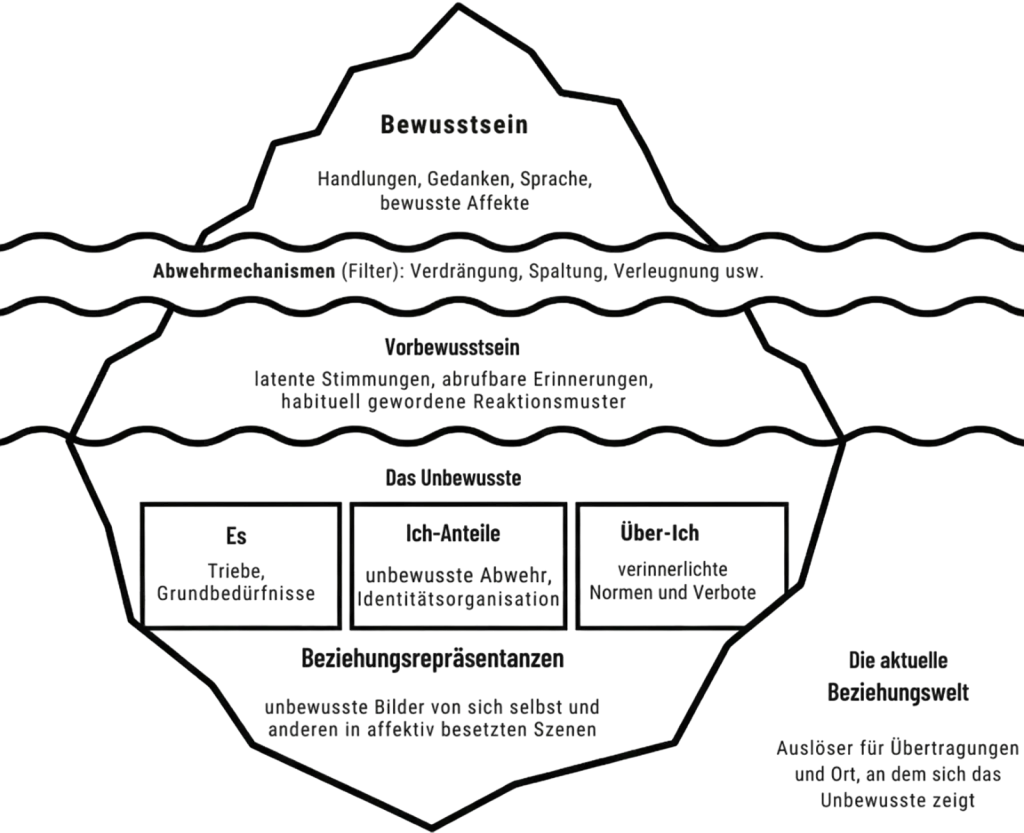
Defense mechanisms are not a flaw. They are an achievement of the soul—often a wise one—that has carried us through a time when we had no other choice.
Defenses as Filters
There are many such mechanisms, and they do not all work the same way. Some respond to a conflict—that is, to a desire that clashes with an internalized prohibition. They do this by pushing something below the threshold of consciousness. Here are four examples:
Repression: An unbearable feeling or a threatening memory is pushed so far away that, in the end, we no longer even know it ever existed.
Displacement: Frustration with one's boss spills over into the family in the evening. The feeling is directed at a less threatening substitute target, because the actual target would be too risky.
Reaction Formation: Those who fear intimacy come across as deliberately independent. Those who are not allowed to acknowledge their own anger are conspicuously friendly. The forbidden impulse manifests as its opposite.
Rationalization: The real reason remains unconscious, and another, more acceptable one takes its place. Someone does not apply for the job they’ve been hoping for and convincingly explains that the conditions would have been poor anyway.
As different as these four may seem, they all require the same thing: a reasonably stable inner image of ourselves and of the people who are important to us. Only then can a feeling continue to work behind the scenes without shattering the entire image.
Defense as a Division
Splitting is older than these mechanisms and works differently. It doesn't hide any feelings. It changes the image we form of a person.
To understand this, it helps to look back to the beginning. A very young child experiences his mother in separate moments: Sometimes she is there, warm and kind. Sometimes she is out of reach, and in that moment, she is completely bad to the child. These two aspects of the mother do not yet belong together. The child is not yet able to think: That's the same person who loves me and is still making me wait right now.
This ability develops over the course of a child’s first few years of life. It becomes more firmly established sometime between the ages of three and five. The child can now hold a single, complete image of a person within themselves—an image that encompasses both the good and the bad. This image remains intact, even when the person is currently angry, disappointing, or unavailable. The mother hasn’t disappeared just because she’s upset. She’s still the same person.
As long as we lack this ability, there is only one solution: to keep the incompatible things separate:
Polarization: People and situations are divided into either purely good or purely evil. Not out of malice, but because the ambivalence of loving the same person and being angry with them at the same time would create more inner tension than one can bear. The feeling does not disappear into the unconscious. The image of the other person breaks down into two separate halves—one good and one evil—that alternate with one another.
Projection: We perceive in others a feeling of our own that we cannot bear in ourselves. It's not me who's angry—it's the other person. The feeling isn't buried—it's simply shifted: from within oneself to another person.
Denial: A reality that would be too painful to face is simply ignored.
To name just a few mechanisms of splitting. This early form of defense responds to the most fundamental of the fears mentioned: the fear of being overwhelmed. For those who do not yet have a reliable inner image capable of holding a contradictory feeling, that feeling threatens to overwhelm them. Keeping things separate is then not a form of concealment, but a protection against being overwhelmed.
The Price of Defense
As useful as these mechanisms once were, over time they take their toll.
What we push away doesn’t disappear. What we keep submerged demands to be expressed. It takes energy to keep it submerged permanently—energy that’s then lacking for other things. And it distorts our perception: Those who had to lock away their anger as children often fail to feel it as adults, even when it would be justified and necessary. Those who have come to view closeness as dangerous keep people at a distance who would actually be good for them.
What is kept separate remains divided. The world then repeatedly breaks down into good and evil: people are idealized and soon afterward devalued; relationships swing from closeness to disappointment. And when that separation fails, the very thing it was meant to protect against descends upon us: a feeling that overwhelms us.
The protection that used to help is now holding us back.