FIND PSYCHOTHERAPY

PTV 11: The Format of a Psychotherapy Session

FIND PSYCHOTHERAPY Von Haegermann 5 min. reading time July 2026

Contents

At the end of the psychotherapy consultation—the first step on the path to psychotherapy—you will be given a form with several boxes: the PTV 11 form. Its official title is „Your Individual Information on the Psychotherapy Consultation Hours„, a standardized form used nationwide by the National Association of Statutory Health Insurance Physicians (KBV).

It summarizes two things on a single page: the preliminary findings from the session and a recommendation for how to proceed with psychotherapy.

Where the form comes from

Psychotherapy Appointments

A psychotherapy session is the conversation that results in the completion of the form. The Psychotherapy Agreement Section 14, paragraph 1, stipulates that it takes place „in sessions of at least 25 minutes, up to six times per case of illness, and up to ten times per case of illness for children and adolescents.“ According to Paragraph 3 of the same section, at least 50 minutes of this must have taken place prior to a probatory session, acute treatment, or guideline-based therapy. This explains the practical rule of „once for 50 minutes or twice for 25 minutes“: both options meet the requirement.

In its own patient information sheet, KVB Bayern consistently refers to the psychotherapy consultation as an "initial consultation.".

Who fills out the form, and who doesn't

The psychotherapist who conducted the session fills out the form immediately after the session ends.

For psychotherapy practitioners who are filling out the form themselves, the National Association of Statutory Health Insurance Physicians has a separate Help with Filling Out the Form published.

The five fields in detail

Five fields are listed on the form, each with its own task.
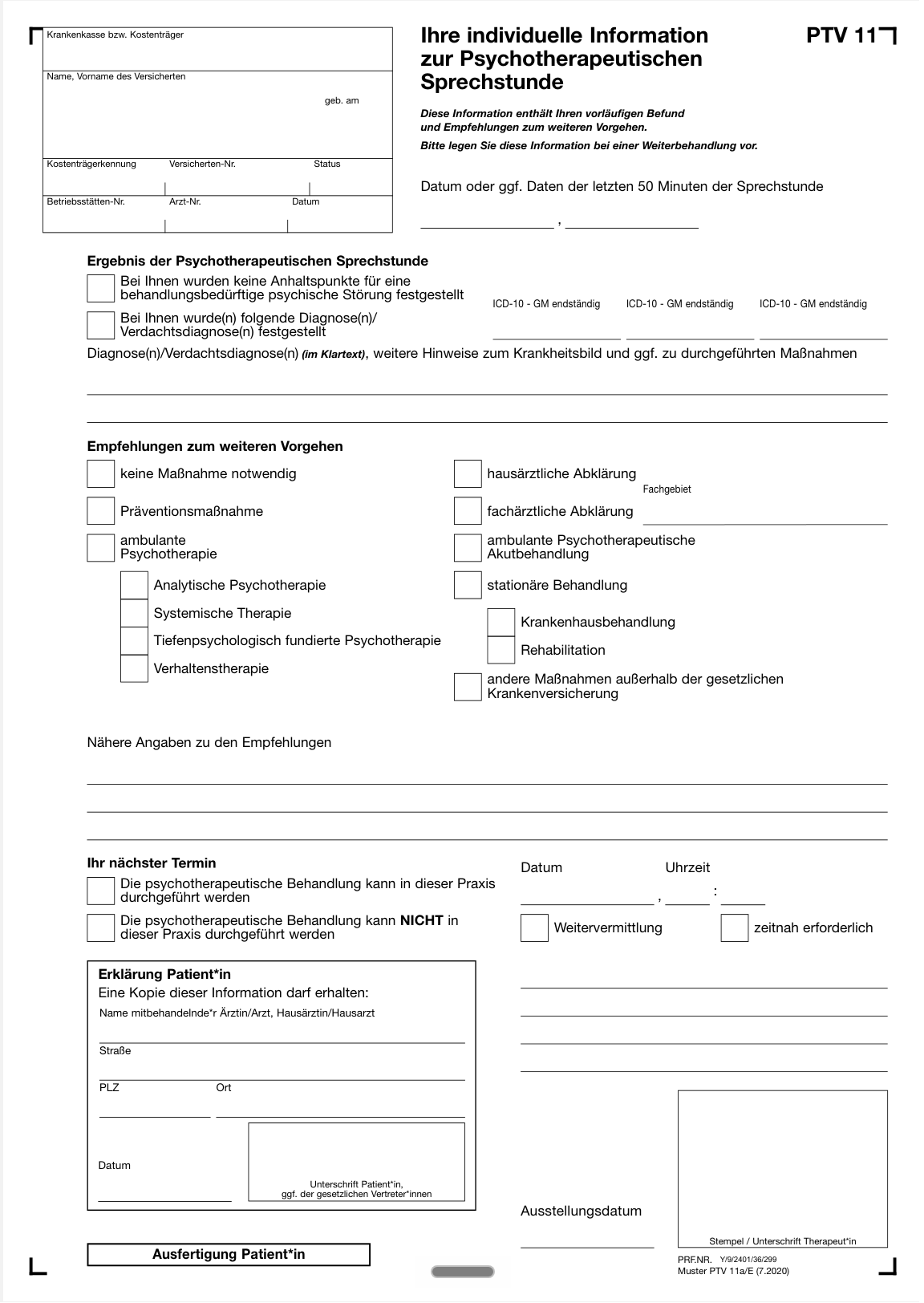
Patient copy of the psychotherapy form with all five fields filled out

Field 1: The date

This indicates when the session took place: either one 50-minute session or two 25-minute sessions. This is mandatory before every preliminary session, every acute treatment, and every guideline-based therapy—that is, the actual psychotherapy.

Field 2: The Findings

There are two boxes to choose from. Either „No evidence of a mental disorder requiring treatment was found in your case,“ or „The following diagnosis(es)/suspected diagnosis(es) were found in your case,“ with space for up to three ICD-10 codes. Below that is a separate line: Diagnosis(es)/Suspected diagnosis(es), in plain language. The form requires the diagnosis to be written out in full: a letter code alone is not sufficient.

Field 3: The Recommendations

Several options can be selected here; the list is long: no action required, preventive measures, outpatient psychotherapy using the four guideline-based approaches (analytical, systemic, Based on depth psychology and behavioral therapy), evaluation by a primary care physician, evaluation by a specialist in a specific field, acute outpatient psychotherapy, inpatient treatment, hospital treatment, and rehabilitation. The last box has its own description: “Other measures not covered by statutory health insurance.” More on that later.

Field 4: Your next appointment

This is where it is determined whether a referral code for psychotherapy will be issued and how urgent the psychotherapeutic treatment is. More on this in the next section.

Field 5: The patient's statement

The last field is yours: You decide whether your family doctor should receive a copy, with space to fill in their name and address.
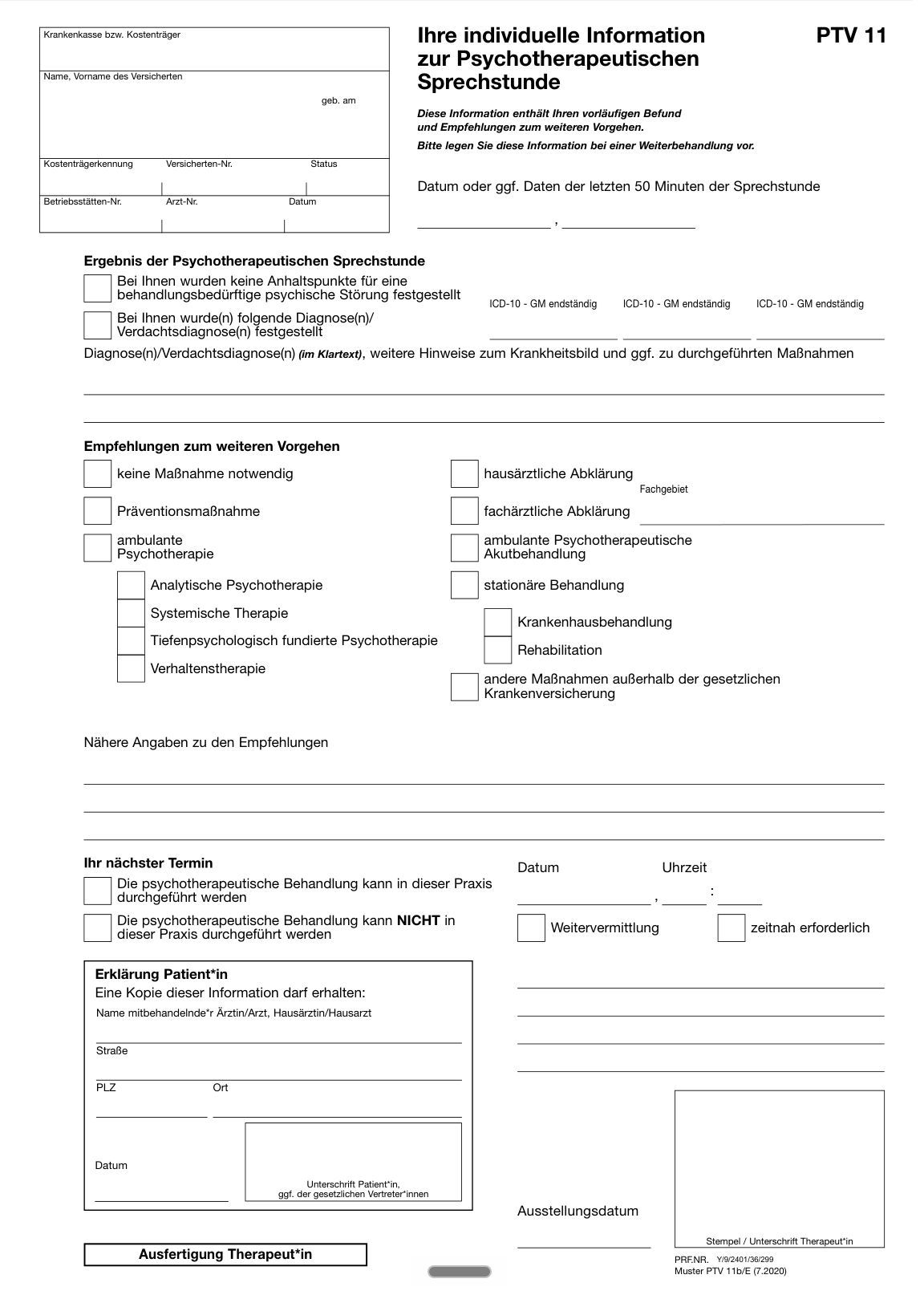
Clinic copy of the form, identical in text to the patient copy

The form is provided in duplicate, with identical text generated by carbon copy: Form PTV 11a for you, Form 11b for the practice. The only difference in the footer is between „Patient Copy“ and „Therapist Copy.“ It’s a good idea to briefly glance over the form when you receive it. If you have a question or notice an error, just give the practice a call—even the next day—and they’ll usually correct it without any trouble.

What to Do with the Form

The Cross That Matters: required in a timely manner

Only the check mark next to “required promptly” opens the path to the Appointment Service Center (TSS). Without this check mark, there is no entitlement to a scheduled preliminary hearing, with him, anyway. In the case of a recommended acute treatment, the rules are clear: both “referral” and “prompt action required” must always be checked.

It can take up to 35 days from the time the code is issued until the actual appointment; for emergency treatment, it takes two weeks. Details can be found on the Page on the Urgency Code.

What to Do With It Now

Please present this information at your next appointment. In other words, do not put this sheet away in a drawer; bring it with you to your next doctor’s office or treatment facility.

If "Forwarding" is checked in Field 4, this includes a Mediation Code. Using this code and your insurance number, you can call the number 116117 Contact TSS, which will then find a spot for the recommended diagnostic testing or acute care. A detailed description of exactly what the code can do and where its limitations lie can be found on the a dedicated page for the referral code.

How long the pass is valid

There are two different deadlines involved in this question. The form itself states No expiration date: Neither the psychotherapy agreement nor the KBV’s form-filling guide specifies a validity period, and the forms have been in circulation unchanged since July 2020. Instead, the referral code for psychotherapy is time-limited, and the rules regarding it can be found on the page about the urgency code.

Where to Get the Form

You will receive the form from your practice. It is not intended for you to print out yourself: The Psychotherapy Agreement expressly requires psychotherapists to have these forms available during consultations. It is a duplicate set with a carbon copy.

Anyone who searches for it online anyway will mainly find samples and templates from commercial providers. For the actual assignment, the only document that counts is the form from the practice where the consultation took place.

An Overview of the Twelve Forms

The so-called PTV 11 is one of twelve forms that are part of the psychotherapy agreement:

  • PTV 1: Request for Psychotherapy
  • PTV 2: Therapist Information
  • PTV 3: Guidelines for the Report to the Reviewer
  • PTV 4: Assessment Assignment
  • PTV 5: Expert Opinion
  • PTV 6 and PTV 7: vacant
  • PTV 8: Envelope for the Expert Review Process
  • PTV 9: vacant
  • PTV 10: General Patient Information on Outpatient Psychotherapy
  • PTV 12: Reporting of Acute Treatment

If you can't get a spot in psychotherapy

Not every referral through TSS results in a therapy slot. If your search is unsuccessful or the referral code expires, you can initiate a new referral. Under certain circumstances, the cost reimbursement process may also be an option: You find a psychotherapist on your own and apply to your health insurance provider to have the costs covered. You can find out how this works on my page about Reimbursement for Psychotherapy.

The PTV 11 form also includes a box labeled „Other measures outside of statutory health insurance.“ This is not a third route to obtaining a therapy slot, but rather a catch-all category for forms of assistance that are not part of regular health insurance-covered psychotherapy. This could include, for example, a family, life, or addiction counseling center, a social psychiatric service, or a self-help group. The specific type of assistance recommended should be listed in the „Further details on the recommendations“ field.

Psychotherapy paid for out-of-pocket at a private practice also takes place outside the health insurance system. However, checking the box alone is neither a recommendation nor a guarantee that the health insurance provider will cover the costs.

If you're still unsure which path is right for you, you can find the various options in my Guide to Finding a Treatment Facility.

Frequently Asked Questions

Where can I find a template for the form?

You can obtain Form PTV 11 from the practice where your appointment took place. Although commercial templates for psychotherapy are available online, they are not valid for the actual reimbursement process.

Who is allowed to fill out the form?

The psychotherapist fills it out immediately after the psychotherapy session. The primary care physician does not issue it: People who search for it online are usually referring to the consultation report or the referral for psychotherapy.

What do I do with this form?

Submit it to the nearest practice or treatment center for your psychotherapy; this is indicated at the top of the form. If “Referral” is checked in Field 4, you’ll need a referral code to use when calling 116117 to find a spot for psychotherapy.

How long is the form valid?

The form itself has no expiration date. Only the referral code for psychotherapy, which you can receive along with it, is valid for a limited time.